



 6 min read
Nela Richardson, Ph.D. , Tim Decker
Last month, we gave you some surprising facts about the health care sector. This week, we turn our attention to knowledge work and the white-collar jobs that comprise this employment category.
With the rise of artificial intelligence, much has been made about the decline, or potential decline, of the knowledge worker, those people whose jobs require them to use their educational expertise and minds to solve complex problems and drive innovation rather than physically produce goods or deliver routine services. But contrary to conventional wisdom, knowledge work has continued to expand as a share of U.S. employment.
Management expert and author Peter Drucker is credited with coining the term “knowledge worker” in 1959, defining it, in essence, as people who think for a living. It wasn’t until the advent of the personal computer and the internet that knowledge work really took off, driving a rapid rise in white-collar jobs.
At ADP Research, we define knowledge workers as people who have a level of freedom to use their expertise to create something new.
While knowledge work exists in every industry, it’s heavily concentrated in the professional and business services supersector, a high-level industry grouping that includes lawyers, accountants, scientists, engineers, and architects, just to name a few.
Over the last 25 years, this supersector’s share of U.S. private employment has been growing, rising from 14.9 percent of all jobs in January 2000 to a record 17.6 percent in January 2022, according to the BLS Quarterly Census of Wages and Employment, a near-perfect count of U.S. employment sourced from state tax data.
But over the past three years, professional services has lost ground. In January 2025, workers in this supersector accounted for 16.8 percent of U.S. employment.
Don’t be fooled. Despite this dip, the spotlight on knowledge work shines as bright as ever. That’s because recent job losses in this supersector can be traced to reductions in administrative and support roles, a category that includes office managers, janitors, and security guards. As a whole, these jobs require fewer skills, pay less, and aren’t categorized as knowledge work. They were also disrupted by the pandemic, while many knowledge workers were granted the permanent ability to work remotely at least part of the week, reducing demand for support teams tied to work locations such as janitorial staff.
Administrative and support jobs as a share of employment in the professional services supersector fell from 47.5 percent in January 2020 to 39.5 percent in January 2025.
Over the same period, the share of people in highly skilled work tied to professional, scientific, and technical services climbed more than 7 percentage points.
A deeper look at the data reveals a clear difference in employment gains between work that requires the application of professional knowledge and expertise – think lawyers and accountants – and work that generates innovation in technology and research. The former lost share, while the latter gained.
Legal services employment fell from 15.8 percent of professional services jobs in January 2020 to 11.2 percent in January 2025. The share of accounting, architecture, engineering, design, and advertising jobs also shrank.
In contrast, roles in computer programming, infrastructure, and design had such strong growth over the last 25 years that they now make up the largest share of employment in professional and business services.
Occupations tied to science and research also gained ground, with management, scientific, and technical consulting showing the most dramatic growth, growing from 10.1 percent of employment in January 2020 to 17.3 percent in January 2025.
Our take
For more than a decade, ADP Research has been studying knowledge worker sentiment, a project led by Dr. Mary Hayes and Jared Northrop.
This research has shown that knowledge workers have a lot more going for them than people in routine or task-oriented jobs. Knowledge workers tend to be better paid, more loyal to their employers, more engaged on the job, and more confident in their job security.
These positive traits now are being challenged by advances in artificial intelligence and its growing influence on creative and innovation-oriented work. But our research shows that knowledge workers are less intimidated by the rapid adoption of AI than other types of workers, at least when it comes to job security.
To borrow an observation made by Mark Twain and again by Steve Jobs more than a century later: Rumors of the death of knowledge work are greatly exaggerated. At least for now.
THE NER Pulse
For the four weeks ending April 4, 2026, U.S. private employers added an average of 54,750 jobs a week.
It was the fifth straight week of improvement in hiring.
These numbers are preliminary and could change as new data is added.
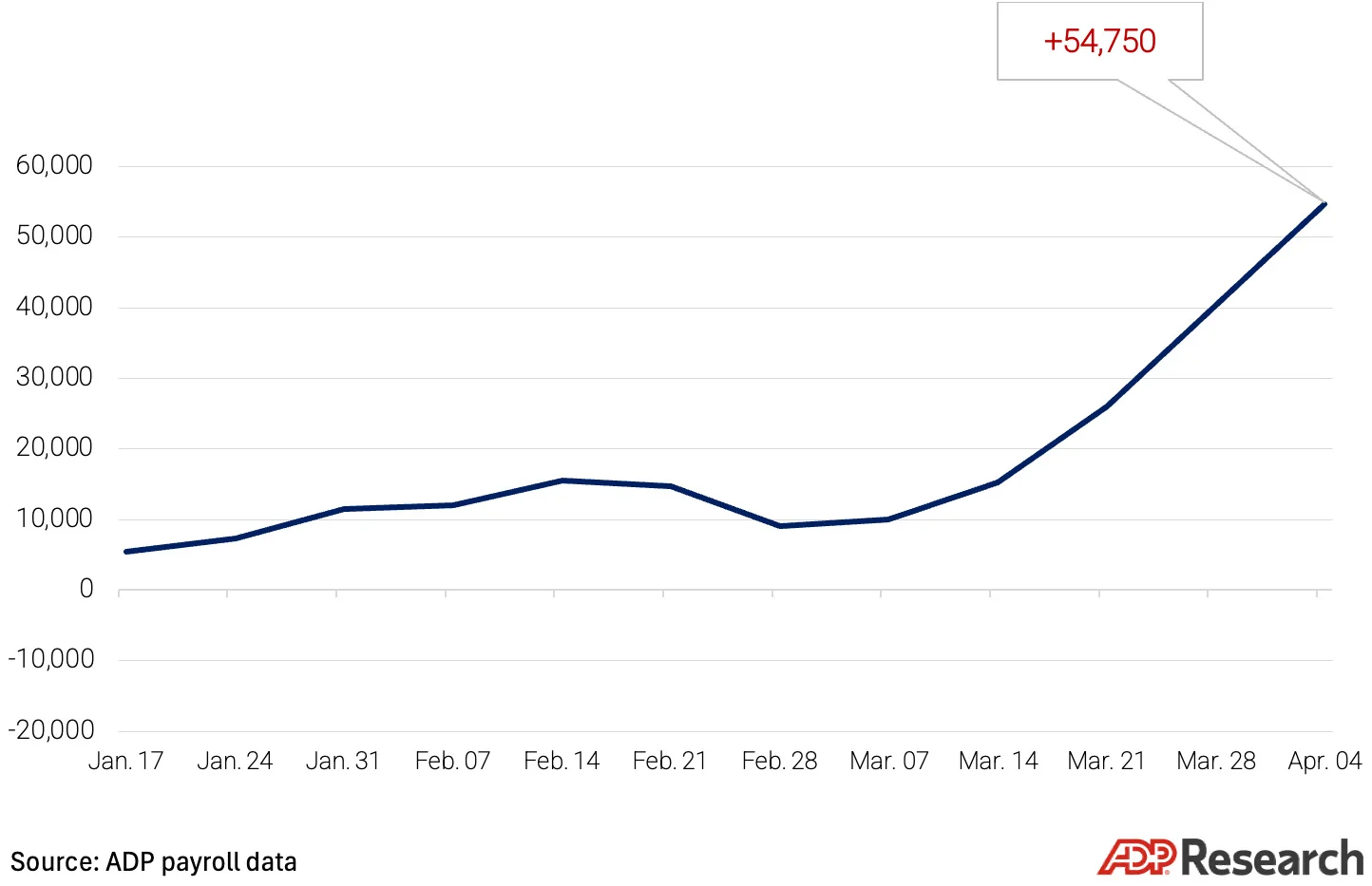
Three times a month, Main Street Macro releases the NER Pulse, an estimate of the week-over-week change in employment based on a four-week moving average. These releases are seasonally adjusted and have a two-week lag to allow for more complete and accurate estimates of real-time employment trends. At the beginning of each month, we publish the National Employment Report, which is built on a reference week that includes the 12th day of the month. We do not publish the NER Pulse during NER release weeks.
Download this week’s NER Pulse data
The week ahead
Tuesday. Consumer news bookends the week, starting with retail sales numbers from the Census Bureau. Data for March will provide a direct line of sight to the health of the consumer and trajectory of the economy. Economists will be watching for evidence of a slowdown in spending pinned to higher gas prices.
The ADP Research Employee Motivation and Commitment Index which tracks how U.S. workers think and feel about their jobs, had a surprising rebound in April after a long run of weakening.
Thursday. Last week, Department of Labor data showed that number of people who filed new unemployment insurance claims fell, but the number of job-seekers who continue to receive benefits rose week-over-week. While initial jobless claims are near historic lows, continuing claims are not. Today’s release of these two numbers will continue to characterize the complexity of the current labor market.
Friday. Preliminary data from the University of Michigan showed that consumer sentiment fell 9 percent in April from a year earlier. Final April data is due on Friday. I’d like to know how well Tuesday’s retail data aligns with the downturn in consumer sentiment.