



 5 min read
Nela Richardson, Ph.D. , Tim Decker
These days, health care is about more than caring for patients. In the past two years, this service industry has become the economy’s biggest manufacturer of U.S. jobs.
Since 2023, the education and health services supersector has accounted for more than 3 in 4 of all private-sector job gains, according to the Quarterly Census of Employment and Wages (QCEW), a near-perfect census of U.S. employment sourced from state-level tax data and compiled by the Bureau of Labor Statistics. By January 2025, this supersector added more jobs than all others combined, accounting for 109 percent of private-sector job gains in the United States.
Health care accounts for about 88 percent of the supersector’s total employment, so it’s safe to say that it’s the engine powering this growth.
Supersectors are high-level industry groupings catalogued by the BLS and used by economists, policymakers, and market watchers to track economic and labor market trends.
Between January 2000 and January 2025, the education and health services supersector grew from 13 percent of private-sector employment to nearly 20 percent, an expansion unmatched by any other supersector. If this trend continues, education and health services could overtake trade, transportation, and utilities as the largest U.S. employment supersector in about five years. Health care alone could become the largest private-sector employment category in the United States in about 10 years.
Health care comprises four main employment categories. The largest of these is ambulatory health care services, a grouping that includes nearly 3.9 million home health aides, who are among the sector’s lowest earners. The remaining three categories are hospitals, nursing and residential care, and social assistance.
From January 2000 to January 2025, ambulatory health care services as a share of health care employment grew from 34 percent to 40 percent. Social assistance, a category also dominated by low-paying occupations such as child care, also increased, from 14 percent to 21 percent. The other two categories lost ground.
QCEW data gives us two indicators of the private-sector employment growth in at-home care. First, ambulatory health care services, the category which includes at-home nursing, grew as a share of health care employment by 6 percentage points.
Second, nursing and residential care facilities, the institutional alternative to in-home care, saw an almost identical decrease in employment over the same period.
Three occupational groups within ambulatory health care services also grew their share of employment. A catch-all category of other health practitioners, which includes chiropractors, optometrists, psychologists, and therapists, grew from a 10 percent share of employment to 14 percent. Outpatient care centers, which includes family planning, and home health care services, which includes at-home nursing, also grew.
Other occupation categories are becoming less dominant. Chief among them are doctors’ offices, where the share of employment fell by 10 percentage points to 33 percent.
These changes suggest a shift in health care hiring toward private at-home care and away from institutional and public health care, a change that’s riding on the demand of a demographic tailwind of the country’s rapidly aging population. As Americans age, more of them are opting to stay in their homes rather than move into assisted-living facilities.
Our take
Unlike past labor market upheavals, this one isn’t being driven by technology. People—older people in particular—are having a profound effect on labor supply and demand in the United States.
On the supply side, some 10,000 people turn 65 every day. This huge baby-boom generation, born between 1946 and 1964, is helping to make the U.S. population as a whole older. As they age out of the labor market, the supply of prime-age workers between the ages of 25 and 54 is shrinking.
On the demand side, the country’s growing population of retirees is the wealthiest generation in U.S. history, and one of their biggest expenditures is health care.
Our analysis suggests that this aging population might be driving both large gains and compositional changes in health care employment, with the trend moving toward at-home care and away from convalescent care and assisted-living facilities.
For more than a century, technological advances have driven labor-market change. The country’s agrarian roots made room for industrial might, which then evolved into the global service economy we have today.
This time around, technology’s power over the labor market might be usurped. Even as artificial intelligence and its uncertain impact grabs headlines, it is another A—aging—that stands to unequivocally reshape the U.S. labor market over the next decade.
The NER Pulse
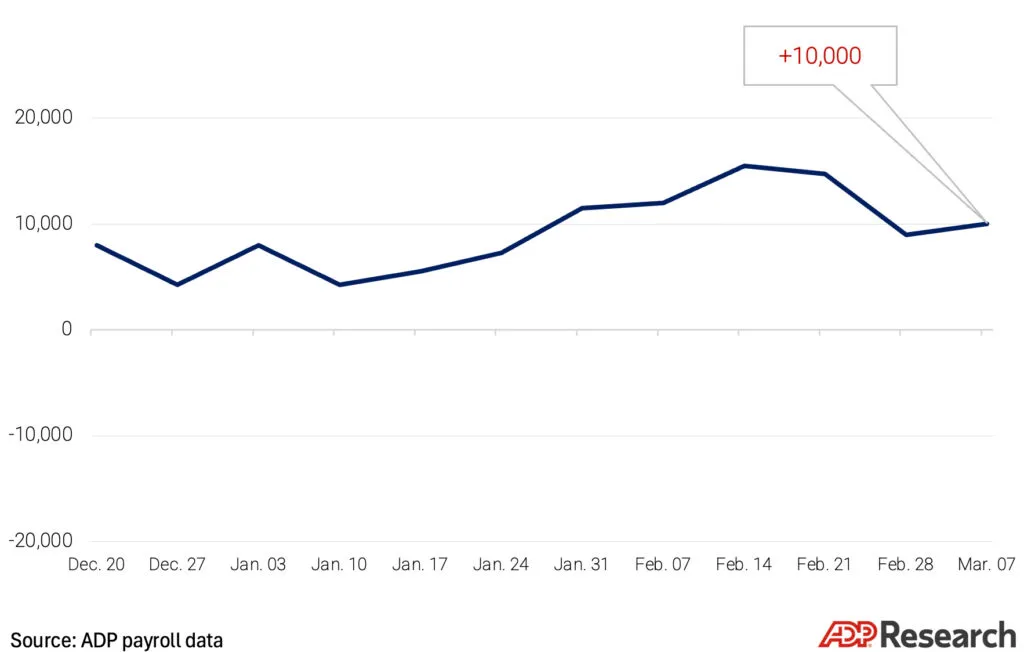
For the four weeks ending March 7, 2026, U.S. private employers added an average of 10,000 jobs a week. Employment gains for the first week in March were little changed from the previous week. These numbers are preliminary and could change as new data is added.
Download this week’s NER Pulse data.
The week ahead
Thursday: It’s a quiet week for releases. Thursday delivers data on everyone’s favorite broken record, initial jobless claims from the Department of Labor. For more than two years, with welcome consistency, this indicator has given no sustained indication of widespread layoffs. Sometimes boring is good.