

 3 min read
Contributors:
Mary Hayes, Ph.D.
Director of Research, People & Performance
Jared Northup
Research analyst, People & Performance
People 26 and younger are more upbeat about their job skills and prospects than their older counterparts.

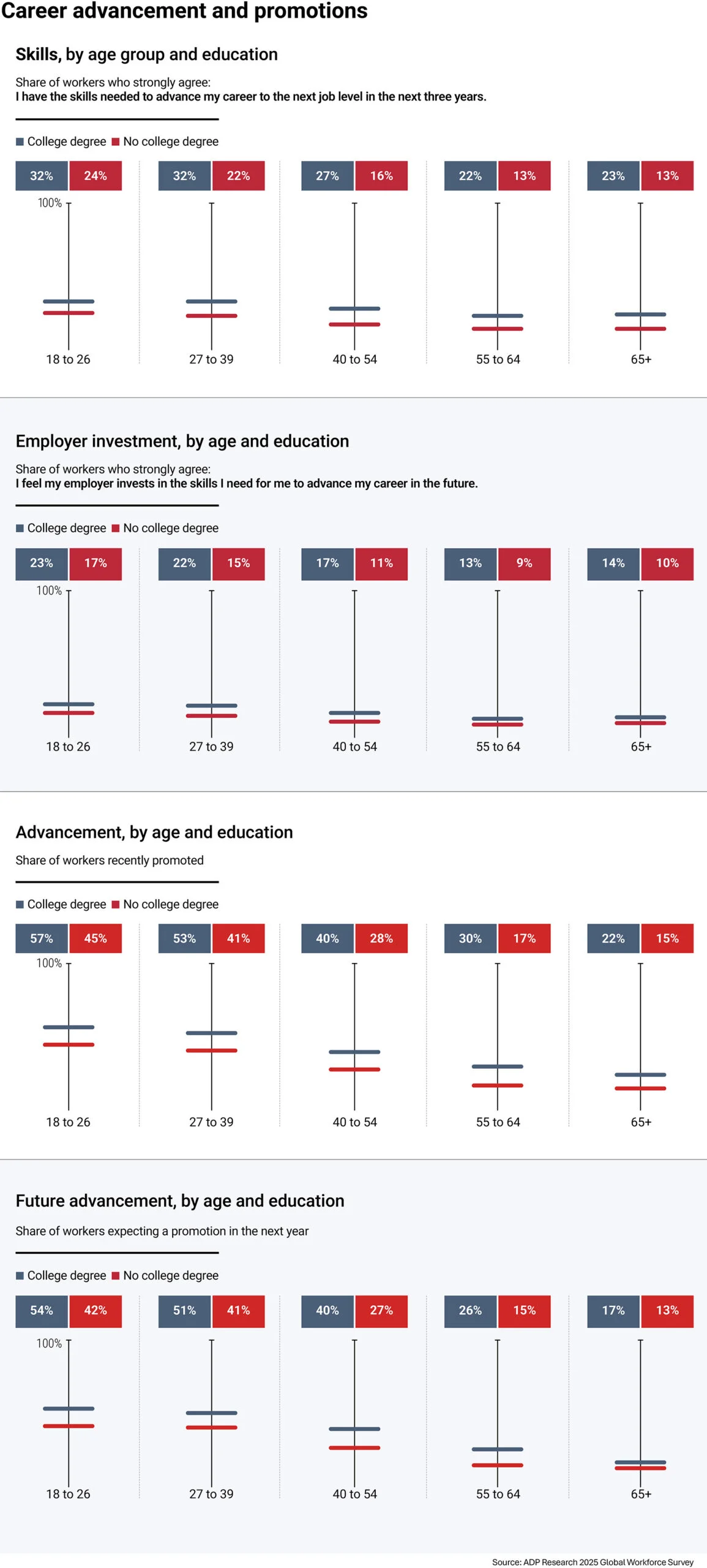
Building on yesterday’s examination of older workers, today we look at sentiment among the youngest workers. As a group, they’re more likely than their more seasoned colleagues to think their skills and education will propel them along a career path. They’re more confident in landing the next promotion, our 2025 Global Workforce Survey showed.1
This sunny outlook, however, is relative. While sentiment among 18- to 26-year-olds tends to be relatively upbeat, there’s plenty of room for improvement. A big share of workers, young and old, told us it’s become more difficult to change jobs, and too many people of all ages feel they lack the skills needed to advance.
Measuring opportunity
When we asked workers if they thought it was harder or easier than it was a year ago to change jobs, 46 percent said it was harder. Only 21 percent said it was easier.
But workers 26 and younger were less likely than older workers to say job-changing had grown more difficult. This sentiment was even stronger among young workers with a college degree or its equivalent.
Regardless of degree status, young workers also were much more likely to feel prepared to advance in their careers than older adults.
Among these young workers, 32 percent of college graduates said they had the skills needed to advance. For workers in this age cohort without a degree, the share was 24 percent. These young workers also were the most likely of all age groups to say their employer is investing in their development.
Workers 26 and younger, particularly those who hold a college degree, also reported the highest rate of recent promotions. They’re also the most optimistic of any age group about receiving a promotion in the next year.
Given that younger workers often start in entry-level positions, it’s not surprising that they have more opportunities than older workers for advancement and higher pay, especially within job levels.
The takeaway
With five generations of people now in the workforce, HR professionals have an unprecedented opportunity to nurture mentorships across age groups. Whether it's younger workers bringing their older colleagues up to date on tech literacy, or more seasoned employees offering support in soft skills, each generation brings its own expertise and experience.
For older workers, targeted investment could pay off for employers. Despite their poor sentiment when it comes to career development and on-the-job support, people 55 and older are just as likely as those in other age groups to find meaning in their work. They're just as likely to be fully engaged on the job. They're the least likely of any group by far to have plans to quit.
As for young workers, there’s room for improvement. Although they're more optimistic than their older colleagues, 45 percent still said it's difficult to change jobs, and only 29 percent strongly agree they have the skills needed to advance.
HR professionals confronted with an age-diverse workforce would do well to learn what drives each generational cohort. Rethink benefits and learning opportunities to make sure they serve employees of all ages. Younger workers might be an employer’s future, but older workers have much to give back.
For more on this story, please see Today at Work 2026, Issue 1.
Contributors:
Mary Hayes, Ph.D.
Director of Research, People & Performance
Jared Northup
Research analyst, People & Performance