



 5 min read
Nela Richardson, Ph.D.
They employ more than a third of the U.S. workforce. They boast low employee turnover. And so far this year, they’ve been responsible for the bulk of U.S. private-sector job creation.
They’re mom-and-pop businesses, and they’re powering the U.S. labor market.
This year in particular, we have some great reasons to celebrate National Small Business Week next month. Without these unsung heroes of the U.S. economy, the labor market would look a lot different than it does.
U.S. businesses with fewer than 20 employees created more than 525,000 jobs in 2025, according to ADP National Employment Report data, more than any other group of private-sector establishments.
And they’re still hiring. From January through March 2026, these tiny businesses have added 169,000 people, outmanning all larger employers.
In 2025, businesses with fewer than 20 employees accounted for the lion’s share of job creation. Without these mom-and-pop establishments, the U.S. economy would have lost 110,000 private-sector jobs last year, ADP data shows.
You read that right. On average, the smallest businesses produced 43,833 jobs a month in 2025. Hiring has trended even higher in the first three months of 2026. Mom-and-pops still have more job gains per month — 66,667 on average — than any other employer size class.
That means that through March of this year, these tiny employers have created some 200,000 jobs, more than the 167,000 new hires the private sector as a whole contributed to the economy in the first quarter. While the smallest businesses gained, certain groups of small- and mid-sized employers have shed jobs on net this year.
And there’s more. Turnover at small employers typically beats that of their larger competitors. In March, the turnover rate at establishments with fewer than 50 employees hit a record low of 3.9 percent.
When it comes to compensation, bonuses, and benefits, it’s well established that larger employers typically win out over less-resourced small businesses.
But the gap in annual pay growth between employers with more than 500 people and those with fewer than 20 peaked at 3.8 percentage points in May 2022. It since has narrowed and has held at 2.5 percentage points or less for the past three years. In March 2026, year-over-year pay growth at the smallest employers lagged pay growth at big employers by only 2.3 percentage points.
My take
If ever there was a good excuse for sheet cake in the break room, this is it.
Over the past year, small employers have doggedly continued to grow their payrolls while bigger companies have shed jobs or notched lackluster hiring gains.
These Main Street businesses rarely grab headlines, but maybe they should. When it comes to U.S. employment, the little mom-and-pop engine of our economy is the biggest thing powering the labor market.
THE NER Pulse
For the four weeks ending April 11, 2026, U.S. private employers added an average of 39,250 jobs a week. After a strengthening trend, hiring was downwardly revised in the first week of April.
These numbers are preliminary and could change as new data is added.
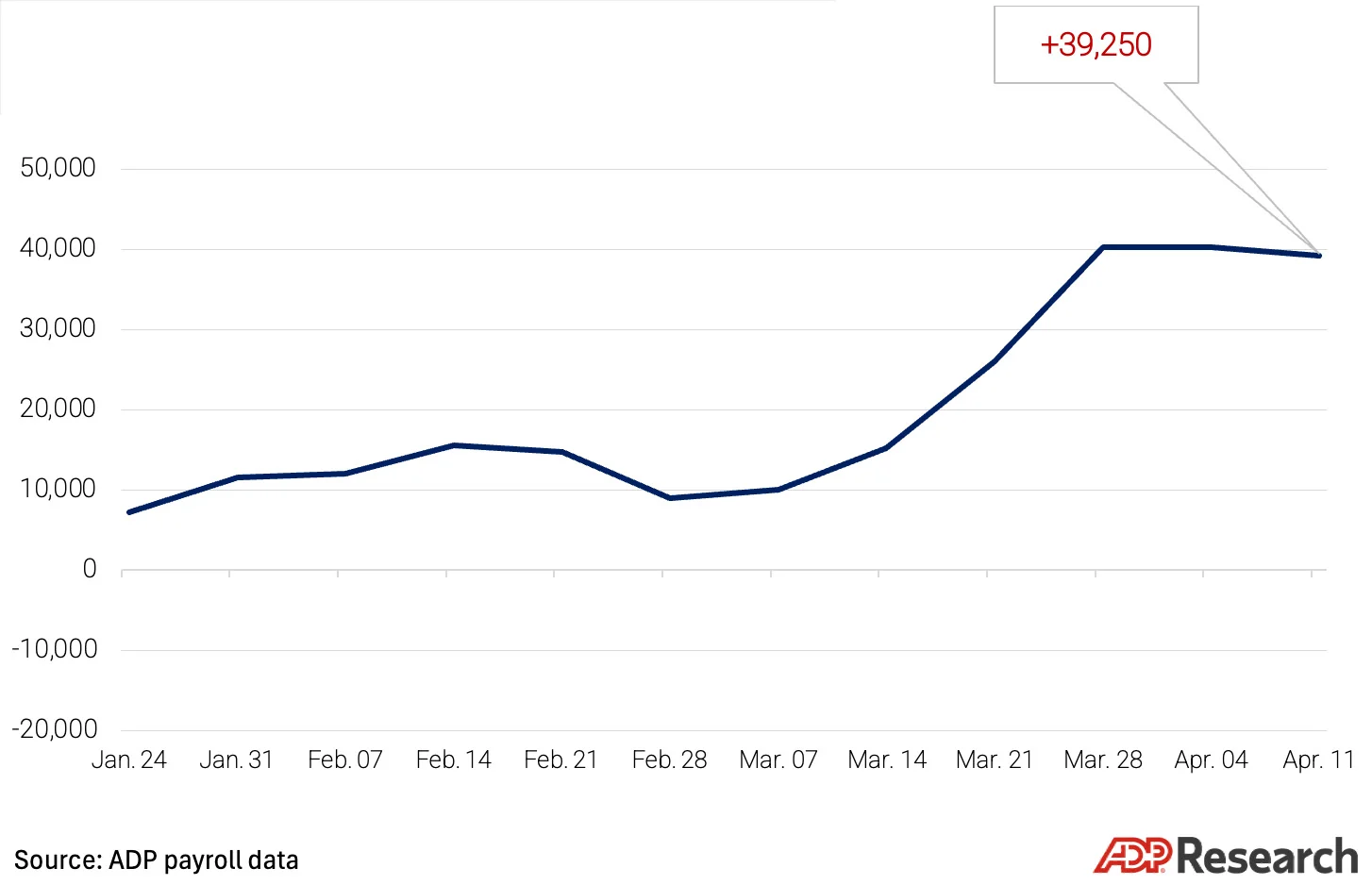
Three times a month, Main Street Macro releases the NER Pulse, an estimate of the week-over-week change in employment based on a four-week moving average. These releases are seasonally adjusted and have a two-week lag to allow for more complete and accurate estimates of real-time employment trends. At the beginning of each month, we publish the National Employment Report, which is built on a reference week that includes the 12th day of the month. We do not publish the NER Pulse during NER release weeks.
Download this week’s NER Pulse data
The week ahead
Brace for a busy economic week!
Tuesday. When will house price growth stop its slide? Annualized price growth for residential real estate has slowed from 6.5 percent in February 2024 to just 0.9 percent in January 2026. We’ll get February data today from S&P Cotality Case Shiller.
Consumers struck an optimistic note in March, according to last month’s Consumer Confidence Survey from the Conference Board. But gas prices have continued to rise, and we’ll see if that optimism was tested in April.
Wednesday. Census Bureau data on orders for durable goods will provide a look at demand for big-ticket items such as appliances, cars, and computers.
Census also will give us a look at residential construction. We’ll get information on housing starts and permits for February and March.
The highlight of the economic week for economists and investors will be today’s decision on interest rates from Federal Reserve policymakers.
Thursday: Initial jobless claims have held at historically low levels for more than four years now. Still, this weekly release from the Department of Labor is a not-to-be-missed high-frequency economic indicator.
The Labor Department also provides a fresh look at compensation costs in its first-quarter Employment Cost Index.
Over at the Bureau of Economic Analysis, we’ll get the first estimate of first-quarter GDP. The bureau also will release data on personal spending for March.
Finally, two days after the Fed rate decision, BEA will give us its latest inflation read via the Fed’s favored metric, the Personal Consumption Expenditures Price Index.