



 5 min read
Nela Richardson, Ph.D.
Here’s what the data said about the labor market in 2025: Hiring slowed. Layoffs, as proxied by initial jobless claims, remained near historic lows. And workers were in no big rush to quit their jobs.
Taken together, these numbers might suggest a softening labor market, with fewer jobs and less competition for workers. But hiring and employment churn are only part of the equation. Wages are another. And pay growth was robust in 2025.
Each month, my team analyzes a unique sample of ADP data containing the anonymized payroll records of some 15 million people working in the United States. This data set allows us to see workers who are at the same employer they were 12 months ago, a group we categorize as job-stayers, and workers who have changed employers within the past 12 months, who we call job-changers.
As we reported last week, annualized pay growth among job-stayers was unchanged in December from a month earlier, at 4.4 percent. Pay growth for job-changers rose to 6.6 percent from 6.3 percent in November.
Job-changer pay is highly sensitive to real-time labor market conditions, and it’s sending an important signal: The job market is tighter than it appears.
December pay gains for job-switchers peaked in 2021 at 14.3 percent. The pay premium for switching jobs—that is, the differential between annualized pay gains for job-stayers and job-changers—also hit a high of nearly 8 percent. In other words, people who switched jobs in December 2021 stood to land an 8-percentage-point bump in pay.
Since 2023, however, the pay premium for switching jobs has been less than 3 percent, a symptom of softening demand for hiring since the Great Resignation. The job-changer pay premium ended 2025 at 2.2 percent.
It’s a paltry number. The labor market provided greater incentive to switch jobs even during the throes of the pandemic in 2020, when the December pay premium was 2.7 percent.
But here’s the crucial difference. In 2025, the low pay premium for job-changers was accompanied by faster pay growth. The annualized pay gain for this group was just 5.7 percent in December 2020. It was 6.6 percent in December 2025.
For job-stayers, annualized pay gains were just 3 percent at the end of 2020. By the close of 2025, they were 4.4 percent.
And there’s another complication: We can’t attribute stronger wage growth to larger job gains.
Education and health services had the largest number of new private-sector jobs in 2025, but workers received only a 2.2 percent pay bump when they switched jobs. In the high-turnover leisure and hospitality sector, which produced the second-largest number of new jobs, workers were actually rewarded for staying put. Job-switchers in this sector lost ground when it came to pay.
In fact, the three sectors with the largest job-switching premium in December were construction, financial activities, and natural resources and mining. All three showed choppy hiring in 2025.
My take
Every free market has two ways of signaling scarcity or tightness: quantity and price.
Even though new job creation (quantity) slowed in 2025, employee pay (price) showed solid growth.
As ADP’s anonymized payroll data shows, pay growth can be robust even as hiring slows.
So, what does that mean for the economy? It’s good news for consumer spending, but mixed news for inflation. Employers are incentivizing workers to stay put, but they have to increase employee pay more than before to keep them.
THE NER Pulse
For the four weeks ending Dec. 20, 2025, private employers added an average of 11,750 jobs a week. The pace of job gains edged up from the prior week.
These numbers are preliminary and could change as new data is added.
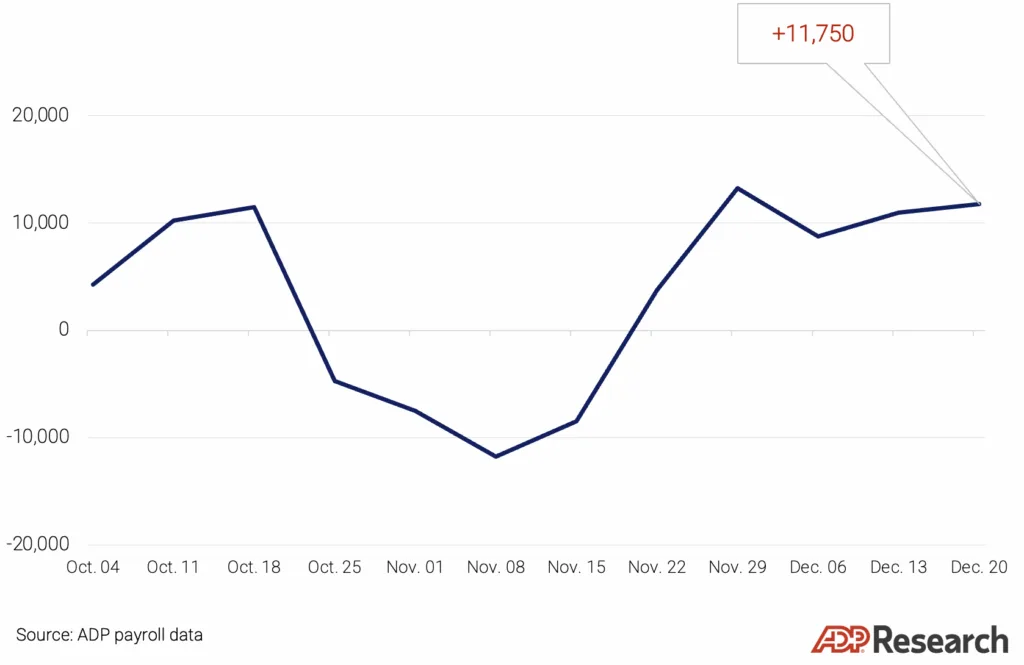
Three times a month, Main Street Macro releases the NER Pulse, an estimate of the week-over-week change in employment based on a four-week moving average. These releases are seasonally adjusted and have a two-week lag to allow for more complete and accurate estimates of real-time employment trends. At the beginning of each month, we publish the National Employment Report, which is built on a reference week that includes the 12th day of the month. We do not publish the NER Pulse during NER release weeks.
Download this week’s NER Pulse data
The week ahead
Tuesday: December’s Consumer Price Index, a measure of inflation from the Bureau of Labor Statistics, will be hampered by missing October data due to the federal government shutdown.
Wednesday: Government releases continue to play catch-up after the shutdown, with November retail sales data from the Census Bureau and the BLS Producer Price Index both delayed by a month.
Thursday: Initial jobless claims reported by the Department of Labor have become almost boring given their consistently low levels of involuntary turnover. But continuing claims, a signal of how long it takes to get a job, trended higher in 2025 and has become the data point to watch in this weekly release.
I’ll be in Davos next week for the annual meeting of the World Economic Forum. The NER Pulse will publish as scheduled, and Main Street Macro will have announcement about a new research project we’re launching with the Stanford Digital Economy Lab.