
Small employers have something to tell us
December 09, 2025
|
 5 min
5 min


The NER Pulse
For the four weeks ending Nov. 22, 2025, private employers added an average of 4,750 jobs a week. This week’s positive number hints at an upswing in the labor market after four straight weeks of negative pulse estimates. These numbers are preliminary and could change as new data is added.
Download this week’s NER Pulse data.
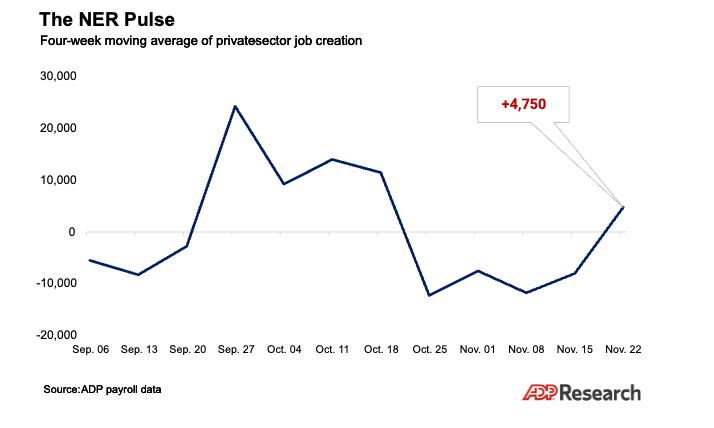
Three times a month, Main Street Macro releases the NER Pulse, an estimate of the week-over-week change in employment based on a four-week moving average. These releases are seasonally adjusted and have a two-week lag to allow for more complete and accurate estimates of real-time employment trends. At the beginning of each month, we publish the National Employment Report, which is built on a reference week that includes the 12th day of the month. We do not publish the NER Pulse during NER release weeks.
Small employers have something to tell us
Small businesses are called the engine of U.S. growth for a reason. Historically, they’ve created nearly two-thirds of new jobs in the United States. Even after the pandemic downturn, small employers led the way on hiring, accounting for more than 52 percent of job gains between 2021 and 2024.
And the smallest of employers, those with fewer than 50 people on the payroll, account for more than 40 percent of U.S. employment and 96 percent of all establishments, according to the Quarterly Census of Employment and Wages from the Bureau of Labor Statistics.
So how are these small businesses doing? Last week, the ADP National Employment Report showed that small establishments lost 120,000 jobs in November, while medium and large firms added 90,000 jobs. Over the previous three months, from August to October, small establishments shed roughly 34,000 jobs per month on average.
Economists pay close attention to small businesses because they punch above their weight. Employers with a headcount of fewer than 50 people account for 57 percent of employment in construction and 60 percent in leisure and hospitality. Employers with more than 500 workers, by contrast, account for just 6 percent and 7 percent of these industries, respectively.
Where did the jobs go?
November job losses were broad-based, with every supersector shedding workers except education and health care (which added 21,000 jobs) and natural resources (which added 2,000). Losses were led by small employers in manufacturing and in professional and business services.
Small businesses lost jobs in both the goods and services sides of the economy, and in both business-to-business and consumer-facing industries.
Regionally, small business job losses were far more concentrated. New England and the Mid- and South-Atlantic bore the brunt, while the Mountain states, the West Coast, and upper Midwest recorded job gains.
What’s pay got to do with it?
Last week, ADP Pay Insights showed that median year-over-year pay gains for job-stayers slowed to 4.4 percent in November from 4.5 percent in October.
Looking at pay data by employer size shows that workers at small businesses tend to earn less than their cohorts at larger employers. They also experience slower pay growth.
In November, median annual pay at the smallest businesses was more than $10,000 less than at medium and large employers. Moreover, median pay grew more than twice as fast at large employers than it did at businesses with fewer than 20 employees.
Part of this difference in pay is by design. While small employers might pay less, ADP Research has shown that they offer workers more scheduling flexibility and options for part-time and contract employment, advantages that some people might value more than higher pay.
My take
As an Indiana University alum, I spent Saturday night watching my team bring home the Big 10 football championship for the first time in the school’s history. It was a Cinderella story more than 80 years in the making.
I spent time before the championship game analyzing the “Small 50”, those businesses with fewer than 50 employees that make up the bulk of U.S. establishments and pay more than 40 percent of its workforce.
Small employers don’t often get the Cinderella-story recognition they deserve from economists and market-watchers. Most labor-market statistics don’t measure their employment gains and losses. But a peek under the hood of the labor market shows just how vital and mighty these small firms are.
November’s small business job losses are worrying for two reasons.
Just like in football, where a few inches can make all the difference in the final score, the pullback in small business hiring led to large losses for the labor market as a whole.
Second, and importantly, small employers historically have been a bellwether for the macro economy. Main Street businesses are more vulnerable to macro headwinds, and they’re typically the first to respond to slowing economic conditions.
By the same token, small firms also typically take the lead in hiring when macro conditions turn positive.
That’s why we’ll continue to focus on these unsung heroes of the U.S. workforce. When hiring pulls out of its slowdown and starts scoring wins, small businesses will be the economy’s MVPs.
The week ahead
Tuesday: The Bureau of Labor Statistics will skip September data as a result of the federal shutdown and release Job Openings and Labor Turnover data for October.
Wednesday: A big day for market watchers. After a two-day meeting to assess the state of inflation and employment, the Federal Reserve Open Market Committee will announce its interest-rate decision.
Thursday: Jobless claims fell to their lowest level in three years last week. It was a positive sign that the unemployment rate has remained low in the third quarter. Today, I’ll be watching to see if continuing claims reported by the Department of Labor have edged down. If they have, it could signal that the labor market slowdown is nearing its end.
