
AI and the great job unbundling
January 20, 2026


Greetings from the annual World Economic Forum. I’m in Davos, Switzerland, where business leaders and policymakers are sharing ideas about improving global cooperation and prosperity.
Lofty goals, to be sure. Achieving them will require the world to find new sources of economic growth and invest in people more effectively.
Both challenges are central to our work at ADP Research. This week in Davos, we’re launching a new partnership with the Stanford Digital Economy Lab that we hope will move the labor-market conversation beyond jobs and toward the work that actually creates value.
As artificial intelligence takes on more workplace activities, our traditional ways of thinking about job creation and destruction will tell only part of the story. Over time, what will matter more is the changing value of the granular tasks and activities that make up a job. Which tasks are becoming more valuable? Which are becoming less so?
We call it the great job unbundling.
Using ADP payroll data, we can assign an economic value to discrete job responsibilities. This information can help people identify the most valuable tasks within their occupations and make more informed decisions about education, training, and career paths. It will give employers a tool for transitioning their teams into high-value work.
When complete, this project will give economists and policymakers a better understanding of labor-force supply and demand, one grounded in the activities and tasks that drive value.
In the age of AI, work won’t be defined by job titles. It will be defined by what people actually do. By making the value of work more visible, we can help workers adapt, grow, and thrive, and help ensure that technological change translates into shared prosperity.
Here’s a slideshow of our Davos presentation. I’ll be back stateside next week.
THE NER Pulse
For the four weeks ending Dec. 27, 2025, private employers added an average of 8,000 jobs a week. The last week of 2025 showed a modest slowdown in hiring.
These numbers are preliminary and could change as new data is added.
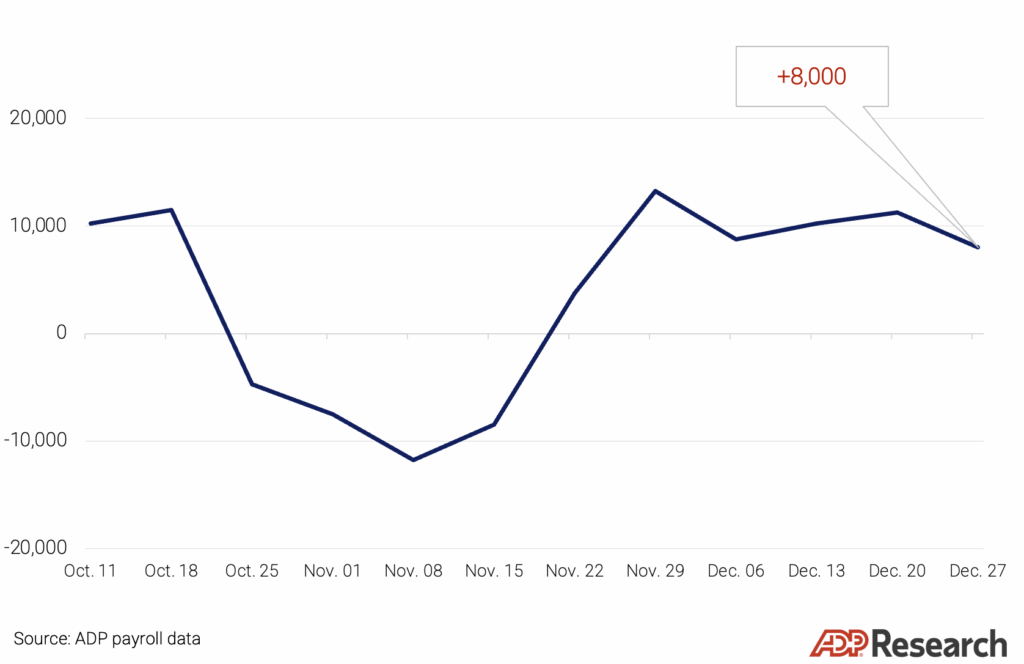
About The NER Pulse
Three times a month, Main Street Macro releases the NER Pulse, an estimate of the week-over-week change in employment based on a four-week moving average. These releases are seasonally adjusted and have a two-week lag to allow for more complete and accurate estimates of real-time employment trends. At the beginning of each month, we publish the National Employment Report, which is built on a reference week that includes the 12th day of the month. We do not publish the NER Pulse during NER release weeks.
Download this week’s NER Pulse data
The week ahead
Thursday: The data point to watch this week is a slightly stale read on the Personal Consumption Expenditures Price Index, economists’ preferred inflation metric. We’ll get delayed data for November from the Bureau of Economic Analysis.
