



 4 min read
Nela Richardson, Ph.D.
The narrative around artificial intelligence is changing rapidly, and so are predictions about its potential impact. Some forecasts point to rapid, sweeping change in the labor market, while others suggest a more gradual evolution.
At the heart of this debate lies a fundamental economic question: How will AI affect productivity?
Economists measure productivity in a variety of ways, but two metrics stand out: labor productivity and total factor productivity, or TFP.
Labor productivity is the easier concept to grasp and measure. It represents the amount of output produced per hour worked. When workers can produce more during the same amount of time, labor productivity rises.
But productivity has a secret sauce that can’t be explained by labor, capital, or output alone. That secret sauce is total factor productivity. TFP captures improvements in business processes, worker skills, technology, innovation, and organizational know-how.
Put simply, the economy gets smarter over time to make more efficient use of its labor and capital. TPF measures that change and how businesses are creating more value from the resources they already have.
A look at history helps bring these concepts to life.
Nonfarm labor productivity rose 2.2 percent in the second quarter from a year earlier as output increased faster than hours worked. This pace of growth is modestly above the long-term average in Bureau of Labor Statistics data going back to 1947. Productivity growth was strongest between 2000 and 2007 and weakest in the mid- to late-1970s.
The drivers of these trends tell an important story.
High energy prices, elevated inflation, and slow economic growth combined to undermine efficient production during the 1970s. The economy also was undergoing a significant demographic shift. As the large baby boom generation – people born between 1946 and 1964 – entered the labor market, the workforce as a whole became younger and less experienced.
This combination of economic and demographic headwinds helped slow labor productivity growth to just 1.4 percent.
The economy of the early 2000s told a very different story. Widespread adoption of the internet and other digital technologies, coupled with strong business investment, helped fuel a productivity boom. At the same time, the young people who had joined the labor force during the 1970s had matured into one of the largest and most experienced workforces in U.S. history. Peak-career boomers armed with investments in new technology gave a powerful boost to productivity.
Which brings us back to AI.
AI's big promise isn’t rapid job creation. Its real potential is to energize total factor productivity by optimizing efficiency, automating routine activities, improving decision-making, and delivering new ways of organizing work.
How do we know whether AI is delivering on that promise?
First, we watch employment. As technology changes work, we want to know if or how job opportunities are changing. To that end, the Canaries Dashboard, a collaboration between ADP Research and the Stanford Digital Economy Lab, tracks employment trends in occupations with varying levels of AI exposure.
And at a more granular level, technology changes tasks before it affects larger employment trends. Our research on job unbundling uses ADP payroll data to assign value to specific work activities so we can understand how the day-to-day tasks that make up a job are performed by employees and how they’re valued by employers.
Second, we watch wages. Wages tell us whether workers are sharing the benefits of innovation. As productivity rises, workers become more valuable. The pace of pay growth can show whether AI-driven productivity gains are translating into improved standards of living.
Together, employment and wages provide the clearest windows into whether workers are finding opportunity and sharing the spoils of technological progress.
My take
Technological progress depends not just on new tools, but on our ability to use them effectively.
To fully understand how the economy’s new ingredient – AI – is changing the recipe for total factor productivity, we need to pay close attention to both employment and wages. Employment measures access to opportunity. Wages measure whether those opportunities are improving living standards.
But AI also demands that we add a third component, one that examines employment and wage data to link pay to distinct work activities. Looking at work through this task-level lens brings us closer to understanding the mechanics of productivity itself, making visible the ingredients that help businesses, workers, and the economy create more value over time.
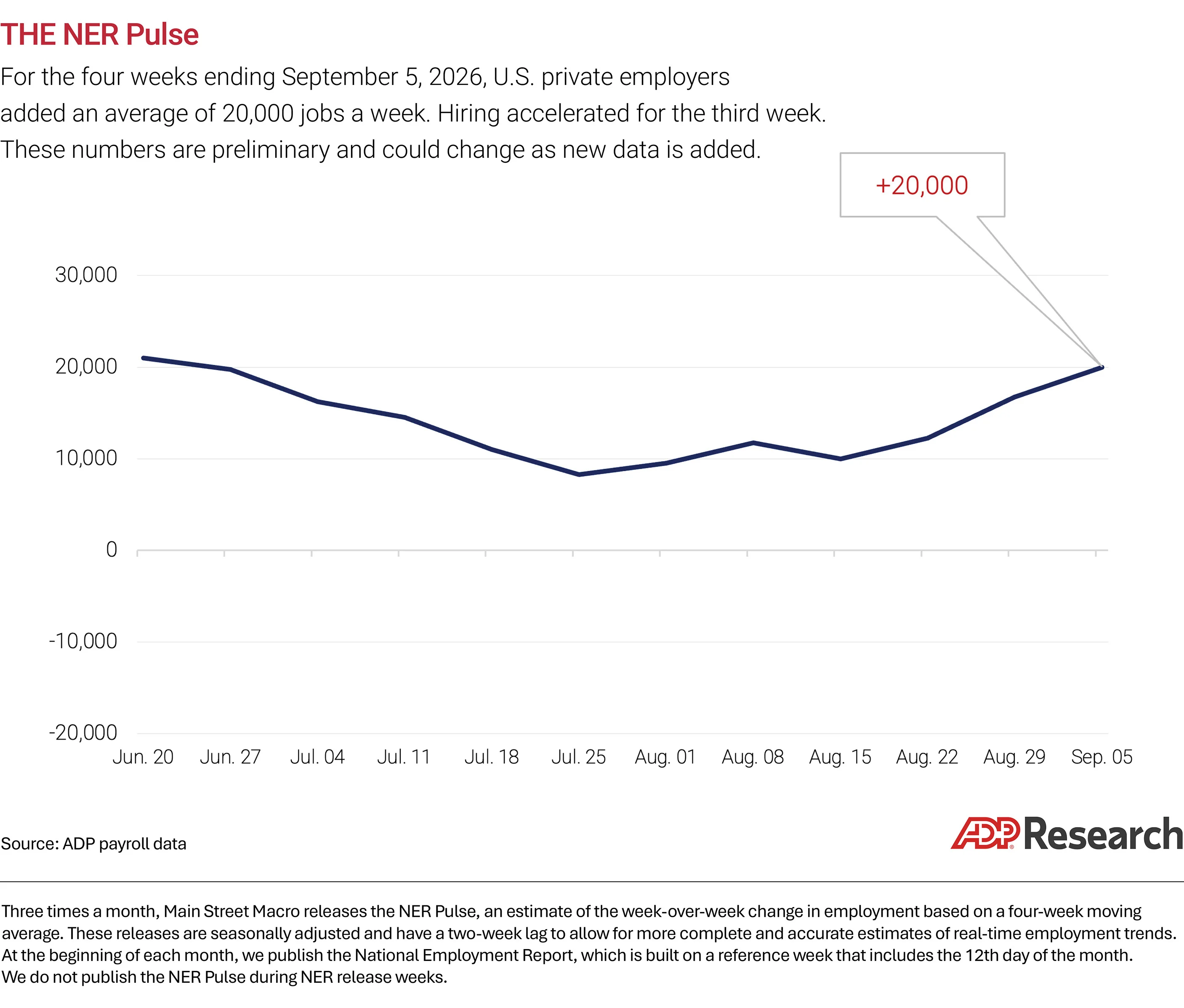
Download this week’s NER Pulse data

The week ahead
Wednesday. The Canaries Dashboard, a project of the Stanford Digital Economy Lab and ADP Research, will provide data on August employment in occupations with varying levels of AI exposure.
Thursday. Some people consider the Department of Labor's weekly initial jobless claims data one of the country’s most uneventful (or boring) economic indicators. I find it one of the most reassuring. The years-long stability of this series remains a valuable signal of labor-market resilience.
Friday: Keep an eye on the durable goods report for August from the Census Bureau. This early look at orders for big-ticket items can reveal whether businesses are continuing to invest for growth or becoming more cautious and pulling back.
The final September read on consumer sentiment from the University of Michigan will show whether inflation remains a top concern.