



 5 min read
Nela Richardson, Ph.D.
Hard data and personal perceptions don’t always tell the same story about the economy.
Last week, we learned that the pace of inflation cooled in July. But we also saw consumer sentiment fall 12.4 percent in August from the previous year.
Of note in the University of Michigan’s sentiment survey was the finding that only 8 percent of consumers expect their income to outpace inflation in the year ahead. Older people, lower-income households, and survey respondents without a college degree reported some of the sharpest declines in confidence.
This pessimism might seem difficult to reconcile with what the data is telling us about the broader economy. Inflation is well below its 2022 peak, wage growth remains positive, and unemployment is at historic lows. But households just aren’t feeling it.
In a new paper, ADP research lead data scientist Liv Wang and I, together with University of Chicago Booth School of Business professors Erik Hurst and Christina Patterson, examined the payroll records of 16 million private-sector workers in the United States between 2016 and 2025.
Our goal was to see how pay had responded to the 2022 inflation shock brought on by pandemic-era supply-chain disruptions and massive fiscal stimulus. What we found tells us something about today’s weak consumer sentiment.
Our central conclusion is both simple and powerful: Inflation has slowed, but many people never fully recovered the purchasing power they lost when prices surged.
In fact, 43 percent of workers who stayed with the same employer from 2021 through 2024 ended up with lower real wages. Even when we include people who changed jobs and landed larger pay increases, 37 percent of workers still were worse off in real terms by the end of 2024.
Here’s what happened, and where we are now.
It’s about prices, not inflation
Economists want to know how quickly prices are changing. Households worry about what things cost now. It’s an important distinction.
When inflation slows from 9 percent to 3 percent, prices are still rising. Cumulative costs continue to build, and consumer expectations shift. The higher cost of housing, food, utilities, insurance, and other everyday expenses takes a permanent toll on family budgets.
So, when it comes to the economy, recovery isn’t measured by cooling inflation, at least not for most people. It’s measured by whether income has caught up to the permanently higher cost of living.
Michigan’s consumer sentiment data reinforces this point. Despite slowing inflation, people aren’t convinced that their financial position has recovered. That’s because, for many of them, it hasn't.
The missing wage catch-up
Before the pandemic, workers who stayed with the same employer typically amassed gradual gains in purchasing power. Raises, promotions, and accumulated experience usually translated into modest but consistent real wage growth.
The inflation shock of the pandemic broke that pattern.
As price growth accelerated in 2021 and 2022, real wages fell sharply. Nominal pay increased, but not enough to offset higher costs. Real wage growth eventually returned to a more normal pace, but it resumed from a lower level.
This return to normal wage growth doesn’t erase prior losses. Imagine a worker who falls behind for two years and then resumes moving forward. Progress has restarted, but the gap remains.
This helps explain why many Americans feel financially squeezed even as headline inflation has improved.
Employers fell behind
Our study also highlights an often-overlooked feature of the labor market: Pay practices tend to be remarkably consistent, or sticky.
Most employers review pay once a year. They adopt compensation norms that persist for years.
Before the pandemic, a 3 percent raise often was enough to provide workers with modest real income gains. But in 2022, when inflation surged above 7 percent, employers continued to deploy conventional pay practices that had been designed for a lower-inflation environment.
Hence this once-in-a-generation inflation shock led to a decline in U.S. consumer purchasing power that persists today.
Mobility became a financial strategy
Even as the pandemic raged and inflation surged, there were wage gains to be had. Workers who changed jobs generally fared better than people who stayed put. Promotions and off-cycle raises also provided pathways to larger pay increases.
However, as I wrote last week, mobility is not free. Changing jobs requires effort and can carry costs. Even negotiating an off-cycle raise requires skill and leverage that not every worker possesses.
Some people were hit harder than others
The inflation shock hit some groups harder than others.
In 2022 and 2023, low-wage workers initially benefited from strong hiring and were among the most active job-changers, positioning themselves to secure larger pay gains.
Older workers fared less well. As a group, they changed jobs infrequently and landed smaller pay increases in the process. Their loss of purchasing power accumulated. That might be one reason that older consumers posted a particularly sharp decline in consumer sentiment this month. Workers who have fewer opportunities to reset wages might also be the most dissatisfied with the economy.
My take
Workers care less about the direction of inflation and more about the size of their paychecks. Many still feel like they’ve fallen behind. And in real terms, many of them have.
And therein lies a big reason for the gap between positive economic data and negative consumer sentiment.
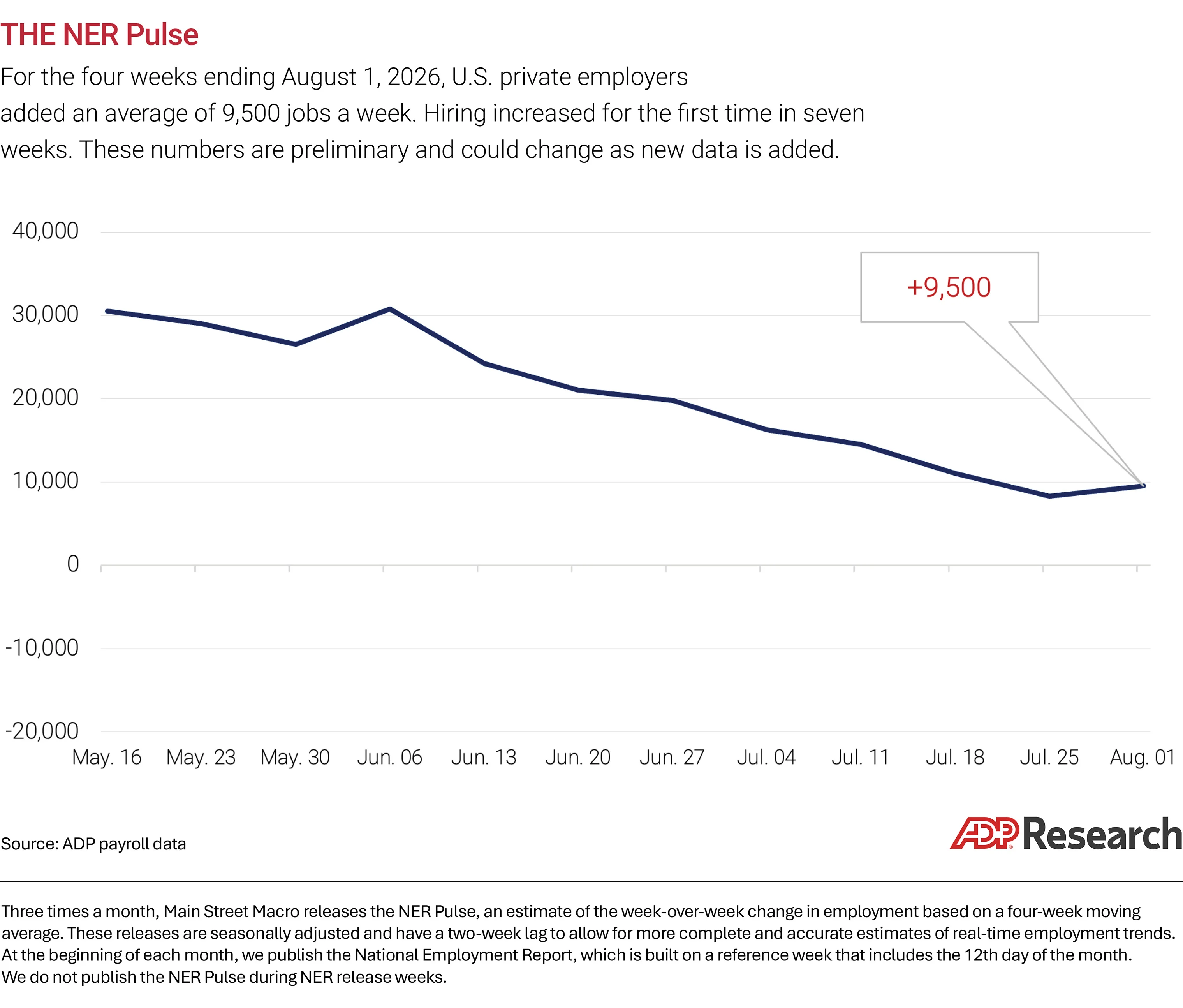
Download this week’s NER Pulse data

The week ahead
Tuesday. After last week’s disappointing retail sales number, I’ll be watching today’s Census Bureau data on housing starts to see whether residential construction, another sizeable consumer component of the economy, also is showing signs of fatigue.
The Employee Motivation and Commitment Index, which tracks how U.S. workers think and feel about their jobs, weakened in August for the fourth straight month. Accommodation and food services showed the biggest decline.
Thursday. Initial jobless claims continue to signal a lack of widespread layoffs, but the broader context is that people might be giving up or pausing their job searches. Because unemployment benefits are awarded only to people who are actively job-hunting, today’s data from the Department of Labor might obscure this emerging trend in labor force participation.