



 4 min read
Nela Richardson, Ph.D.
In July, pay growth for job-changers accelerated to its fastest pace since August 2025. Median year-over-year pay growth for these workers rose to 7.0 percent, while pay growth for workers who stayed put held steady at 4.4 percent. That widened the gap between switchers and stayers to 2.5 percentage points, up from 2.3 percentage points the month before.
The job-changing pay premium still exists, but it’s much softer than it was during the height of the Great Resignation. Back then, people who changed jobs could command high, single-digit pay gains as employers aggressively competed for talent and scrambled to replace workers who left during and immediately after the pandemic.
Back then, workers held considerable bargaining power. Today, they’ve lost some of that leverage. Employers are hiring more selectively, people are changing jobs less frequently, and job-changers no longer command the outsized pay boosts they enjoyed just a few years ago.
In this low-hire, low-fire labor market, does it still pay to switch jobs?
Search costs
Anyone who has applied for a job knows that changing employers comes with a cost. It takes time and effort to monitor job boards, tailor résumés, network, attend job fairs, prepare for interviews, and negotiate offers. Economists call these worker inputs search costs.
One of the biggest search costs is time, for both individuals and employers. Finding the right match of skills and opportunity rarely happens overnight. In a slower hiring market, the process can take even longer as openings grow scarce and employers grow more deliberate.
For unemployed job-seekers, search costs can be even more acute.
The unemployment rate edged lower in July, according to the Bureau of Labor Statistics, but that same data showed that more than a quarter of unemployed workers had been without a job for six months or longer. Long-term unemployment has risen from its post-pandemic lows. For a growing segment of job-seekers, it’s taking longer to find work.
And while the share of the long-term unemployed shrank slightly in July from June, labor force participation also declined. That matters because participation measures both people who are working and who actively are looking for work.
A lower participation rate can suggest that some workers have stopped job-hunting altogether. Indeed, the number of discouraged workers and people who had not searched for work in the prior four weeks is trending higher, according to the BLS data.
For some U.S. workers, the cost of searching, in both time and money, might simply outweigh the expected benefit.
Industry differences
Not all job changes are created equal.
July’s job-changer data shows that the largest year-over-year pay increases were concentrated in goods-producing industries, where specialized skills remain in short supply. Pay growth among white-collar workers was close behind.
Workers in customer-facing sectors generally posted smaller pay gains, while the typical worker in leisure and hospitality actually took pay cuts when they switched employers.
The lesson is straightforward: Whether it pays to switch jobs depends increasingly on where you work, not simply on whether you move.
Is the grass really greener?
Money is only one driving factor for seeking a new job. Sometimes people are in search of better working conditions. But those, too, might be elusive.
ADP Research has shown that worker sentiment tends to improve over the first several years on a new job and generally peaks at around seven to eight years of employment. Sentiment often is weakest during the first year or two, when new employees are still adjusting, and it tends to soften again after an extended tenure.
That finding suggests that job satisfaction follows a lifecycle. Workers might initially struggle to adapt, eventually find their stride, and later begin seeking out new challenges.
The grass isn’t always greener.
My take
One consequence of low-hire, low-fire labor market we’re now in is a downward shift in the reward of changing jobs.
Workers who successfully switch employers can still earn meaningful pay gains. But unlike during the Great Resignation, when opportunities seemed abundant and big pay increases were the norm, today's employers are more selective.
With fewer openings and longer hiring processes, the payoff from changing jobs remains real, but the cost to gain that payoff has risen.
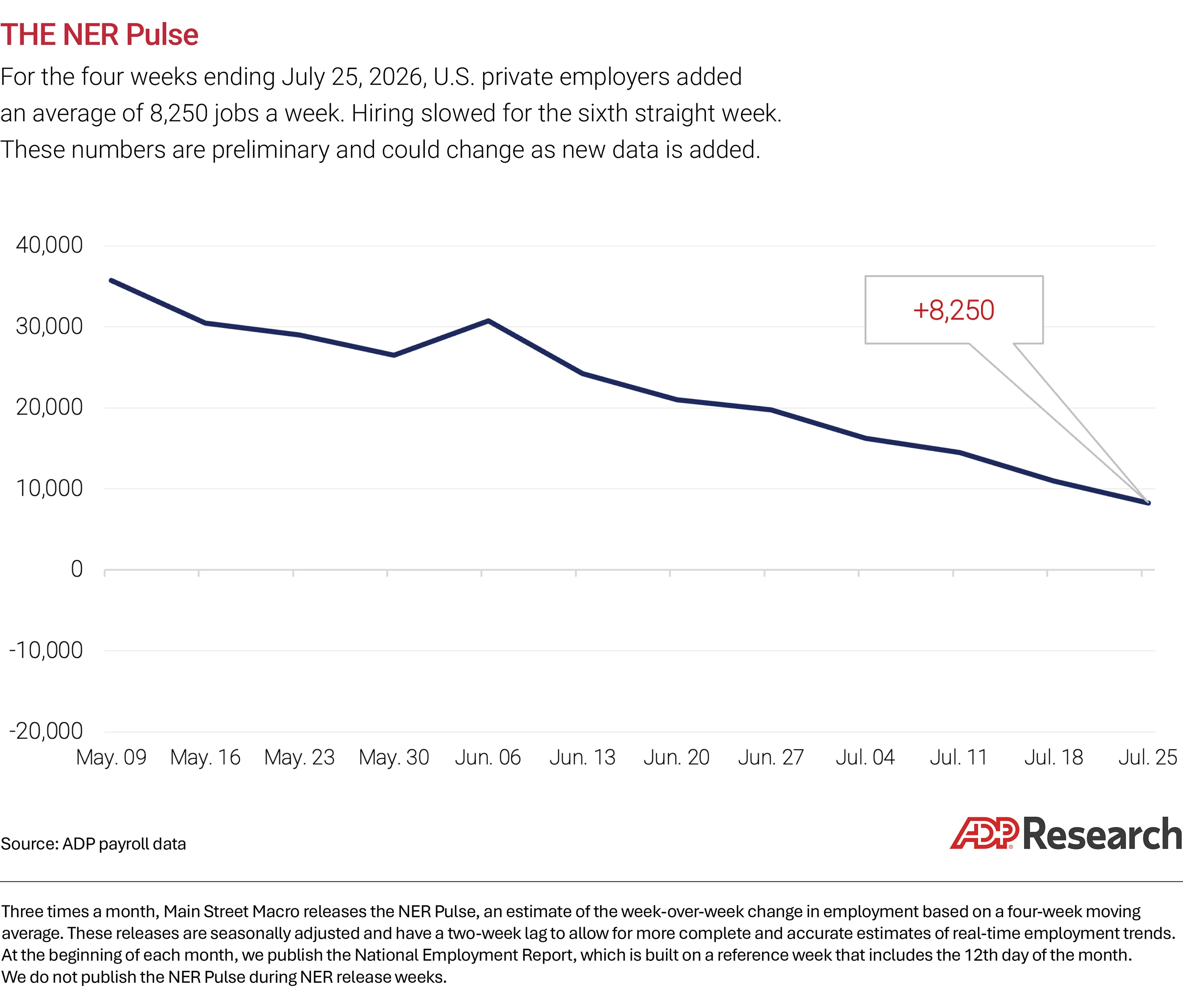
Download this week’s NER Pulse data

The week ahead
Tuesday. In June, the National Association of Realtors cited job growth and rising wages as key supports for existing home sales, despite elevated prices and fluctuating mortgage rates. This week, I'll want to know whether buyers looked past July's softer labor market and higher rates, or whether affordability challenges continued to weigh on existing home sales.
Wednesday. This week's showstopper will be July’s Consumer Price Index from the Bureau of Labor Statistics. When it comes to reading the tea leaves of monetary policy under our new Federal Reserve chair, July’s inflation report could be the most consequential data release of the year so far. A stronger-than-expected reading would reinforce concerns that price pressures remain sticky, while a softer report could give Fed policymakers more room to focus on the slowing labor market.
Thursday. The weekly initial jobless claims report from the Labor Department isn’t likely to shed additional light on last month’s weak hiring data, and I expect claims to remain near historic lows. Also on deck for Thursday is the Producer Price Index from BLS, a measure of pipeline inflation that should deliver new clues about the cost pressures businesses are facing and whether any price increases are likely to pass to consumers in the months ahead.
Friday. Household savings rates remain relatively low and consumer debt has been rising. Both trends suggest that we might soon see cracks in consumer resilience to inflation. The Census Bureau’s retail sales data for July will provide an important check on consumer spending. Meanwhile, even though consumer sentiment remains weaker than it was a year ago, it did improve substantially in July. I'll be watching the University of Michigan’s preliminary consumer sentiment reading to see whether those better vibes continued into August.
ICYMI. To learn more about the economic outlook, labor market, inflation, and challenges facing Fed policymakers in the second half of the year, check out my webinar with Federal Reserve Bank of Richmond President and CEO Tom Barkin, hosted by the National Association for Business Economics.