

 5 min read

Contributors:
Mary Hayes, Ph.D.
Director of Research, People & Performance
Jared Northup
Research analyst, People & Performance
Workers worldwide are anxious about their jobs, which could carry real consequences for employees and employers alike.
Is your job safe? Even with worldwide unemployment at its lowest level in decades, fewer than 1 in 4 workers confidently say yes.
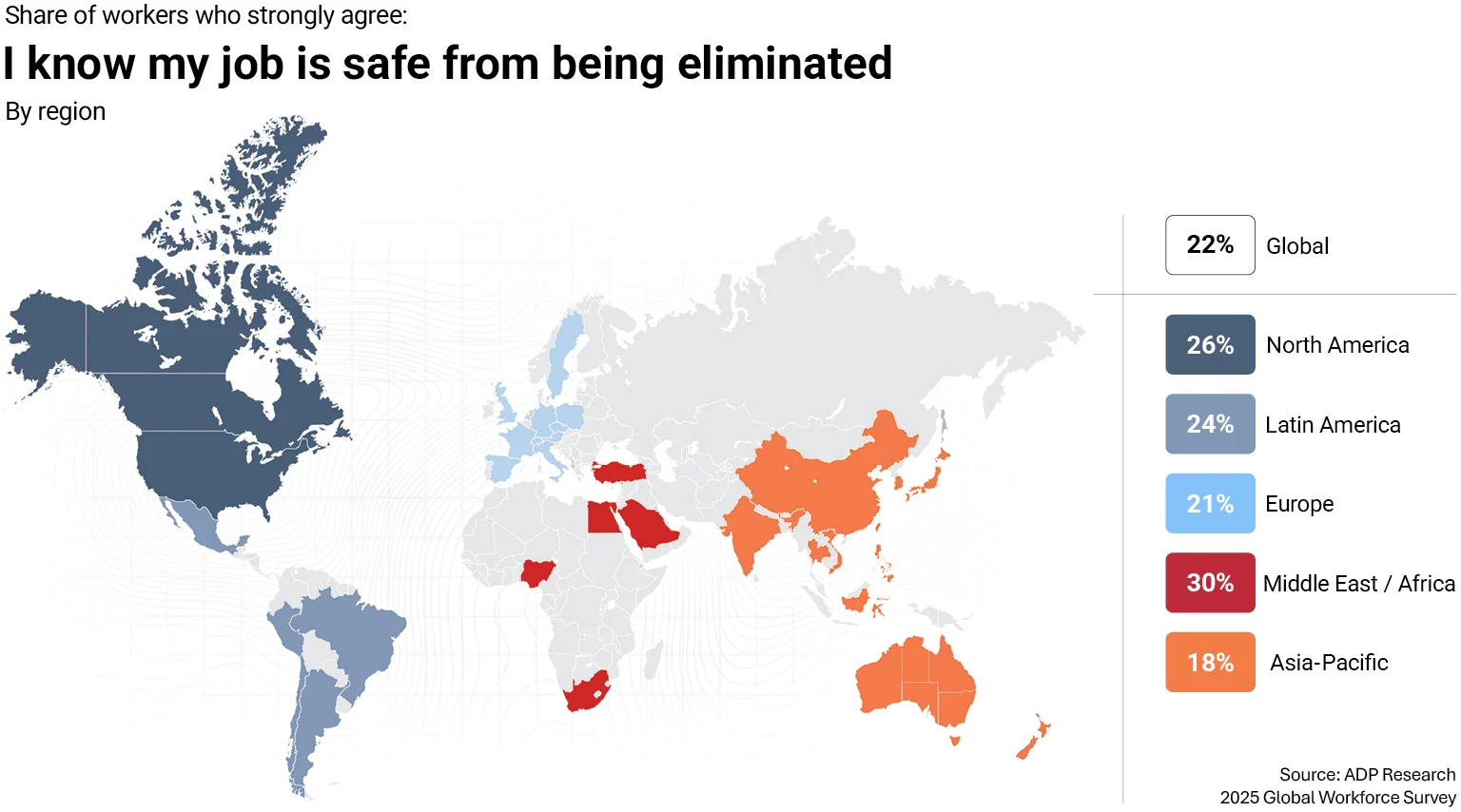
Just 22 percent of respondents to our 2025 Global Workforce Survey strongly agreed that their job was safe from elimination, a share that was little changed from 2024. Anxiety over job security was particularly acute among lower-paid repetitive task workers and people at the bottom of the management hierarchy.1
This insecurity has consequences for employees and employers alike. Our data shows that people who fear losing their jobs are less engaged at work, more stressed, less productive, and much more likely to be spending time and energy looking for work elsewhere.
Our data also revealed big differences by geography, gender, job level, sector, and work type.
The geography gap
Nowhere did we find a majority of workers who said with confidence that their jobs were safe. And in only one market did the share of job-secure workers rise to more than a third. That was Nigeria, where 38 percent of survey respondents expressed confidence in their job security. In Japan, at the opposite end of the ranking, the figure was only 5 percent.
The gender gap
In the Middle East and Africa, women were slightly more confident in their job security than men (33 percent compared to 29 percent). The gender gap in this region was widest in Egypt, where 38 percent of women felt their jobs were secure compared to 31 percent of men.
In North America, this gender gap was reversed. Men were significantly more likely than women to say with confidence that their jobs were safe (29 percent versus 22 percent). The divide was particularly stark in the United States, where 31 percent of men felt their jobs were secure compared to 23 percent of women.
The organizational gap
Confidence rises with seniority. C-suite executives and upper managers (35 percent) were far more likely than frontline managers (21 percent) or individual contributors (18 percent) to say their jobs were safe. This stands to reason, as senior leaders have more insight into the performance of their organization and greater influence over staffing decisions than the people who report to them.
The sector and work-type gap
We found two other big differentiators when it came to job security: Work type and sector.
Thirty percent of knowledge workers said they felt their jobs were safe. This is almost double the share of skilled task workers (18 percent) and repetitive task workers (16 percent) who strongly agreed their jobs were safe from elimination.
These sentiment differences track with sectoral patterns. Survey respondents in finance and insurance, educational services, health care, and technology—sectors heavy with knowledge workers—were more likely to have confidence in their job security.
At the other end of the spectrum were workers in transportation and warehousing, agriculture, manufacturing, and accommodation and food services. These sectors tend to have a higher concentration of repetitive task workers.
Why job security sentiment matters
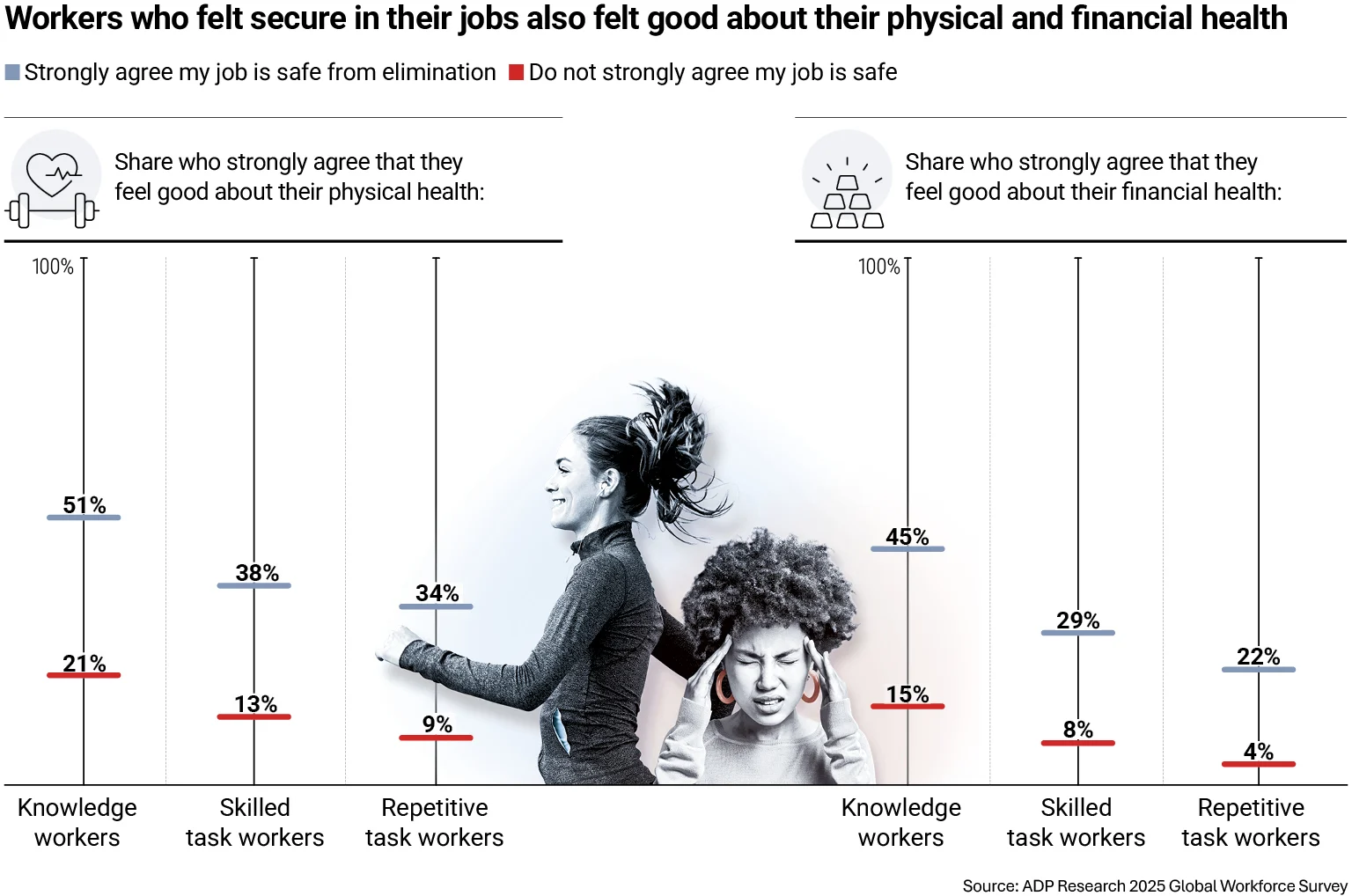
Feeling secure at work goes well beyond basic job satisfaction. Workers in our survey who strongly agreed that their jobs were safe were far more likely to feel good about their physical health and financial well-being.
While the direction of causality isn’t clear, the relationship between job security, finances, and well-being was strong and consistent across all work types.
Our research has established that workers hit a sweet spot of productivity and retention when they’re engaged, highly motivated, committed, and not overwhelmed by stress.
In 2025, workers who felt safe in their jobs met all these criteria. They were:
- 6 times more likely to be fully engaged on the job
- 6.3 times more likely to be highly motivated and committed
- 3.3 times more likely to say they were highly productive at work
- 2 times more likely to say they have no intention of leaving
- 2.5 times less likely to feel overloaded or experience negative stress
The takeaway
In uncertain economic times, job security is top of mind for workers everywhere. And because job security affects worker performance and retention, employers must take heed.
Transparency matters. When jobs aren’t at risk, employers should say so. In the absence of clear information, workers fill the void themselves, often with worst-case assumptions.
Investment matters, too. Workers who strongly agreed that they had the skills needed to advance their careers were 5 times more likely to say their job was safe. Those who felt that their employer invested in their development were 5.3 times more likely to feel secure.
Upskilling isn’t just a workforce strategy; it’s a form of reassurance. Employers who provide clarity and demonstrate long-term commitment to their workers are likely to be rewarded with a more engaged, productive, less stressed, and loyal organization.
For more on this story, please see Today at Work 2026, Issue 1.
Contributors:
Mary Hayes, Ph.D.
Director of Research, People & Performance
Jared Northup
Research analyst, People & Performance