


Is your job safe? When our Global Workforce Survey asked that question of more than 39,000 workers across the world, only 1 in 4 said yes.
The rest of the respondents? Well, they were less confident about their employment status.1Between July 21 and August 4, 2025, our Global Workforce Survey collected responses from more than 39,000 adult workers in 36 markets, stratifying market-level samples by age and gender.
Globally, labor market conditions are solid. Many countries are reporting the lowest unemployment rates they’ve seen in years, according to the International Labour Organization. In the United States, the unemployment rate has been at historically low levels since the end of the pandemic.
Still, U.S. respondents to our stratified random survey were only a little more confident in their job security than their non-U.S. counterparts, with 28 percent saying that their jobs were safe.
These widespread expressions of job insecurity coincide with high levels of economic uncertainty tied to geopolitical concerns, the impact of artificial intelligence, ongoing inflation concerns, and other macro trends.
The confidence barbell
Optimism tends to align with youth. But our survey showed that workers at both ends of the age spectrum had the greatest anxiety when it came to job security. Only 26 percent of the youngest workers we surveyed, those aged 18 to 26, said their jobs were safe. Thirty percent of workers in the next two age cohorts, 27 to 39 and 40 to 54, said their jobs were safe. And workers aged 55 to 64 shared the downbeat outlook of young workers; only 23 percent felt confident about their job security.
Employee sentiment
More recently, workers in the United States have continued to signal insecurity about their job. Our Employee Motivation and Commitment Index, which tracks how U.S. workers think and feel about their jobs, fell in March for the seventh straight month to 129, the lowest level since April 2025. 2The Employee Motivation and Commitment Index tracks how people think and feel about their jobs and employers. ADP Research collects data each month using a panel survey to gather a stratified, random panel sample of 2,500 U.S. workers. The March survey was fielded March 2 to 10, 2026.
Worker outlook
Other recent surveys show a dimming outlook for future employment.
In February, respondents to the New York Federal Reserve’s Survey of Consumer Expectations reported feeling a little less concerned about job loss overall, but they did expect their earnings growth to slow over the next year.
Workers were a bit more upbeat about current labor-market conditions in March data released by the Conference Board. But that positivity disappeared when respondents to the board’s Consumer Confidence Survey were asked to look six months into the future.
My take
Why should economists care about worker feelings when we have hard data about the labor market? U.S. job growth was strong in March, unemployment fell, and jobless claims—a proxy for layoffs—are near rock-bottom levels. Indeed, labor conditions are solid in most of the world.
But worker sentiment still matters. In 2025, people who felt their jobs were safe were 6 times more likely to be fully engaged on the job and 3.3 times more likely to say they were highly productive at work. For employers, confident workers are tied to better performance.
Moreover, our research finds that insecurity doesn’t stop at the workplace. People who reported feeling insecure about their jobs also reported feeling less secure about their finances and even their health.
This ground truth matters. Workers can be the first to sense shifts in hiring, demand, and opportunity in their industry or occupation. Surveys that capture how workers feel about labor-market conditions add an important reality check to hard data and add to our understanding of long-term job viability. And right now, workers are anxious about the future.
THE NER Pulse
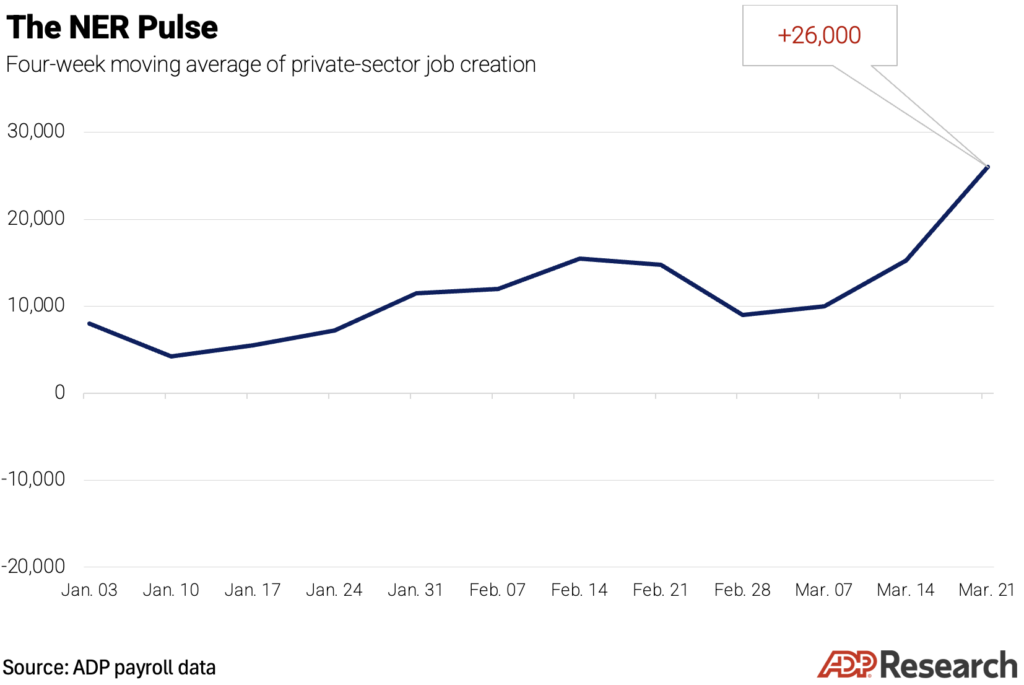
For the four weeks ending March 21, 2026, U.S. private employers added an average of 26,000 jobs a week. It was the fourth straight week of improvement in hiring. These numbers are preliminary and could change as new data is added.
These numbers are preliminary and could change as new data is added.
About The NER Pulse
Three times a month, Main Street Macro releases the NER Pulse, an estimate of the week-over-week change in employment based on a four-week moving average. These releases are seasonally adjusted and have a two-week lag to allow for more complete and accurate estimates of real-time employment trends. At the beginning of each month, we publish the National Employment Report, which is built on a reference week that includes the 12th day of the month. We do not publish the NER Pulse during NER release weeks.
Download this week’s NER Pulse data
The week ahead
Tuesday. One good way to gauge consumer health is to watch what people buy. Durable goods are expensive, big-ticket purchases made by households and businesses. The Census Bureau’s delayed February report on durable goods might be a positive input to first-quarter economic growth after a restrained fourth quarter.
Thursday. Economists generally prefer the Personal Consumption Expenditures Price Index measure of inflation from the Bureau of Economic Analysis to other inflation indicators. However, it’s a print from February and we’ll get a fresher inflation read on Friday, so this PCE release likely will be less for economists looking to see whether a jump in oil prices had an effect on overall inflation.
Last week, Bureau of Labor Statistics data showed that the number workers unemployed for 27 weeks or more had edged down in March. Today, I’ll be looking for any evidence of new layoffs in initial claims data from the Department of Labor. If continuing claims start to drift lower, it would be a welcome sign that jobs are getting easier to find.
Friday. The BLS releases its Consumer Price Index for March, and economists will be laser-focused on the effect of rising oil prices.
