



 2 min read
Mary Hayes, Ph.D., Jared Northup
Struggling to make ends meet? You’re not alone.
Nearly two out of three workers say they’re living paycheck to paycheck. Since February 2024, our monthly Worker Sentiment Survey has tracked this trend, with an average of 64 percent of U.S. respondents consistently telling us that they are under financial strain.1
While our survey doesn’t collect wage information or detailed financial data, workers who report living paycheck to paycheck also report lower productivity, weaker engagement, and greater stress. They’re twice as likely to be actively looking for a new job compared to workers who are more financially secure.
This sentiment spans all levels of workers. Even 58 percent of upper managers say they’re just getting by.
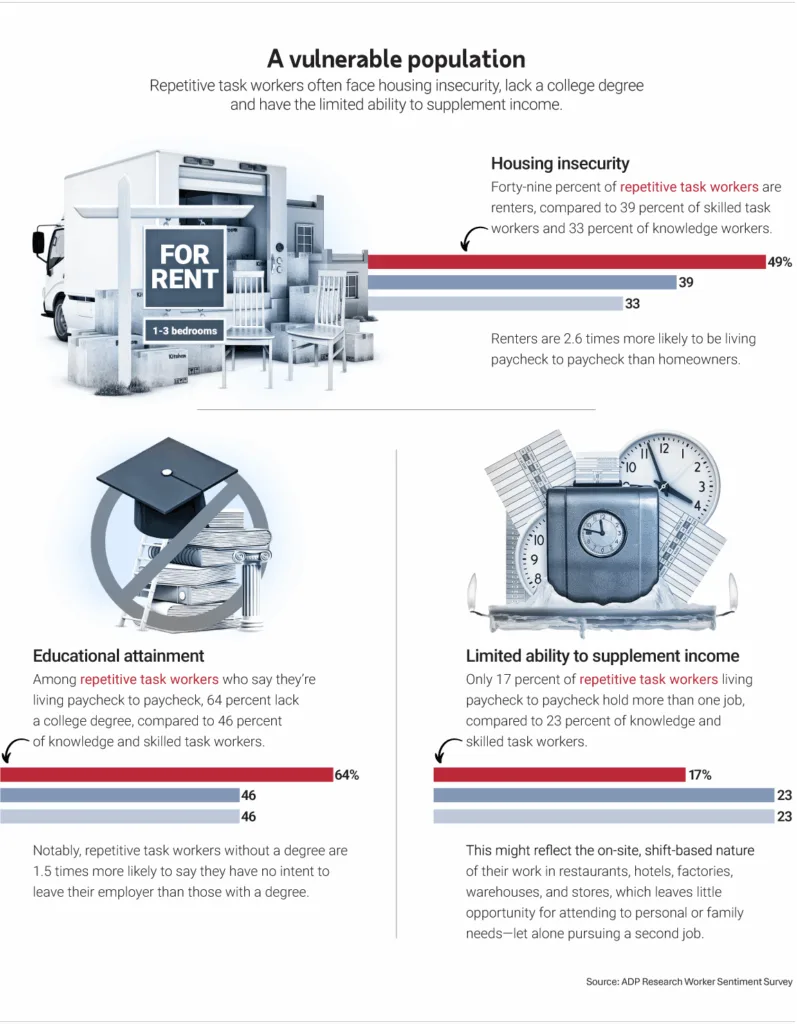
But one group stands out as feeling the greatest financial strain: Repetitive task workers.
Repetitive task workers are employees who work scheduled hourly shifts and carry out routine tasks on a regular basis.2
Thirty-four percent of repetitive task workers in our sample are employed in accommodation and food services, transportation and warehousing, and retail and wholesale trade, sectors characterized by lower pay, fewer benefits, and limited scheduling flexibility.
What we found
It stands to reason that workers living paycheck to paycheck might seek better-paying jobs. Or even just better jobs: Repetitive task workers report the highest levels of stress, the lowest trust in leadership, and the least autonomy. They’re the least likely of all workers to say they love what they do.
However, repetitive task workers who are struggling financially are just as likely as other workers to say they plan to stick with their current job.3
This complex dynamic, where financial insecurity coexists with job retention, might be driven by the limited alternatives available to repetitive task workers, who tend to have fewer skills and more job constraints.
The takeaway
Repetitive task workers are more likely than other employees to struggle financially, yet they’re just as likely to stay with their employers as other paycheck-to-paycheck employees. This financial strain is linked to lower employee engagement, reduced productivity, and greater stress.
While economic conditions and low employee turnover might give employers little reason, or ability, to raise wages, investing in higher pay, if possible, could deliver long-term benefits such as greater productivity, improved employee well-being, and even more worker retention.