 8 min read
Issi Romem, Ph.D.
Long-distance work is splitting geographic cost savings between workers and employers and improving the match between them.
Long-distance work didn’t begin with the coronavirus lockdown; people were collaborating between offices well before then. But four years after the pandemic’s normalization-by-necessity of remote work, many long-distance workers never went back, and their ranks are growing1.
So, does remote work pay? And if it does, for whom? Employees who go remote can raise their standard of living overnight by moving to a city with less expensive housing and an overall lower cost of living. But our research found that employers can share in the geographic cost savings, too. Perhaps most important, the widespread acceptance of long-distance labor has improved the odds that workers and jobs will be well-matched, which stands to help the labor market as a whole.
In earlier studies, we examined cross-metropolitan work—in which the worker and the manager live in different metro areas—to document the unprecedented scale and scope of long-distance work and its geographic implications for cities2. In this study, we examined payroll and HR data of some 1.3 million workers each month to see how the rise of long-distance work has influenced compensation3.
We found that job-stayers who stayed with their team but relocated to less-expensive communities had slower average wage growth than their on-site teammates. That discount suggests that employees are sharing the geographic cost savings of relocation with their employers.
In contrast, people newly hired into long-distance positions won bigger average pay gains than similar job-switchers who took local positions. In some cases, that premium reflects the transition from local work to long-distance work for employers located in higher-paying markets. But we found bigger average pay gains for long-distance workers hired to companies in lower paying markets as well, which suggests something different altogether: Long-distance positions might be helping both workers and employers find a better fit with each other.
The big picture is that the normalization of remote work has created opportunities for employers and workers alike and has the potential to make the labor market more efficient by better matching the right person to the right job.
Sharing the benefits of long-distance work
People can transition into long-distance jobs in multiple ways. The most straightforward scenario is one in which a person relocates without giving up their current job4. When a worker moves to a community with cheaper housing and a lower cost of living, do they maintain their pay level and reap the full geographic cost savings, or does their pay take a hit, giving their employer part of the savings?
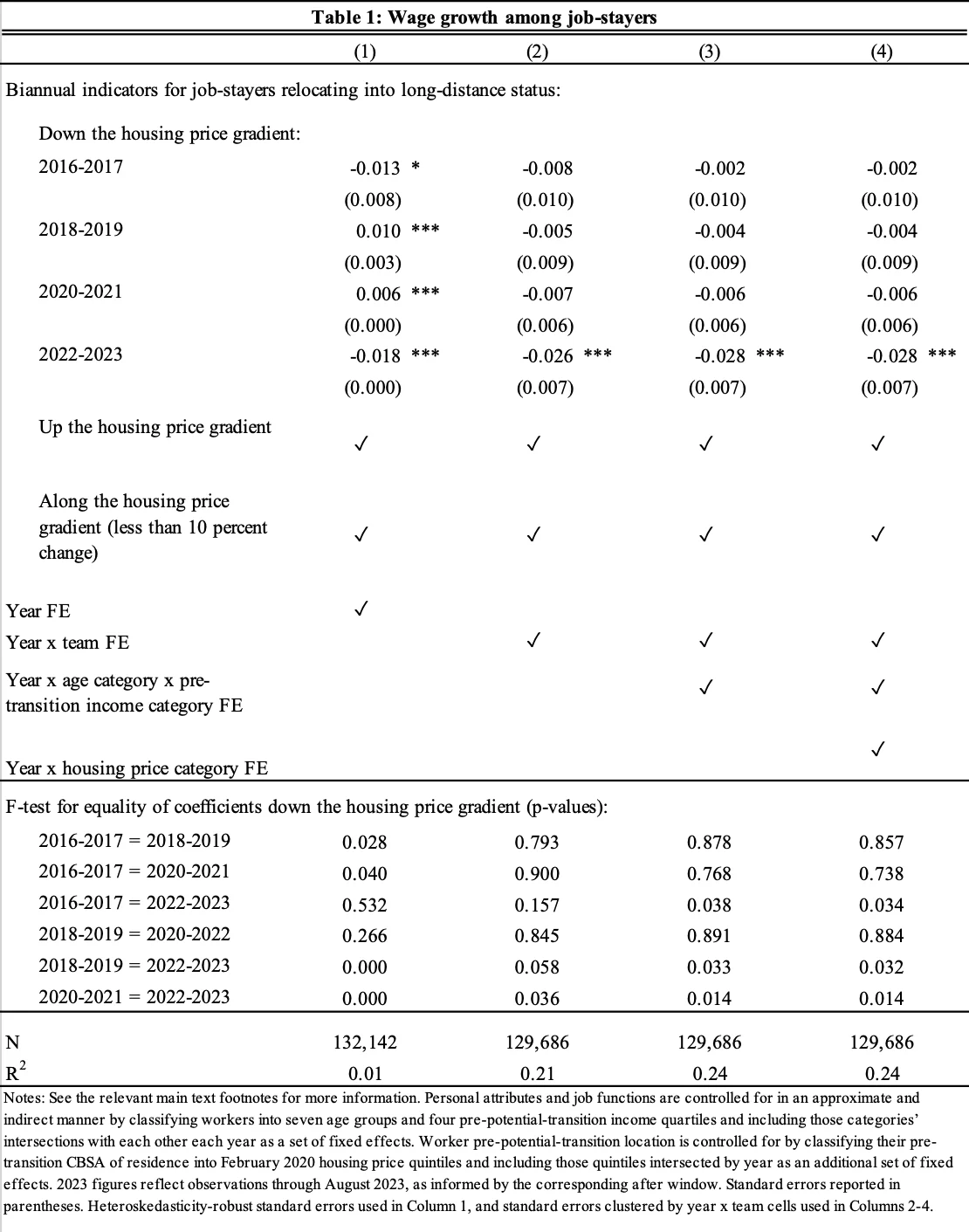
We tracked the gross wages of job-stayers who transitioned from local to long-distance work by relocating to communities with cheaper housing. We compared their earnings in the months before and after the move567. We did the same for teammates who didn’t relocate8. We statistically controlled for factors such as personal attributes, job function, and location to obtain an approximate yet meaningful apples-to-apples comparison of average wage growth9.
Figure 1
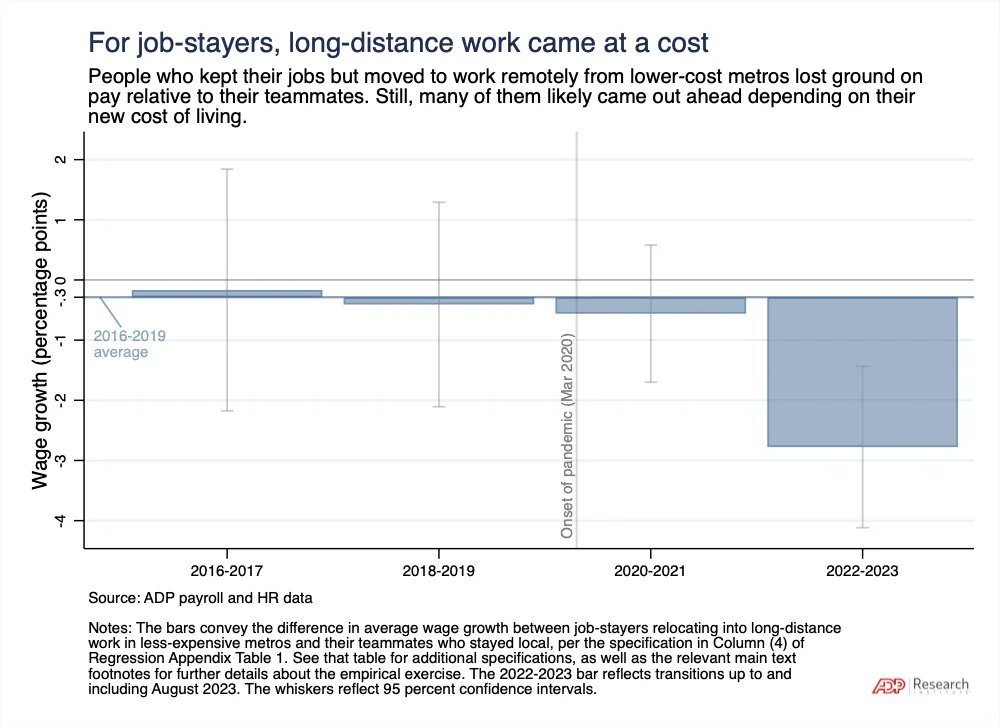
In the four years preceding the pandemic, from 2016 to 2019, average wage growth for job-stayers who relocated to affordability was 0.3 percentage points below that of their teammates, a difference statistically indistinguishable from zero. The difference remained indistinguishable from zero for 2020-2021.
But for 2022-2023, the wage growth deficit increased to 2.8 percentage points10. Given that the median pay gain for job-stayers was 7.3 percent in 2022 and 5.2 percent in 2023, this 2.8 percentage point deficit is considerable1112.
While some employers might have recalibrated workers’ pay in proportion to cost-of-living differences, most did not, because cost-of-living differences are generally far more substantial than the wage growth deficit we found13. That means employers, at least on average, are splitting the geographic savings that flow from relocation with existing workers, with the lion’s share going to the latter.
Finding the right fit
Reducing an employee’s pay can be difficult; setting the wages of new employees less so. With that in mind, employers can better capitalize on geographic cost savings by hiring new long-distance workers for far less than they pay their existing workers.
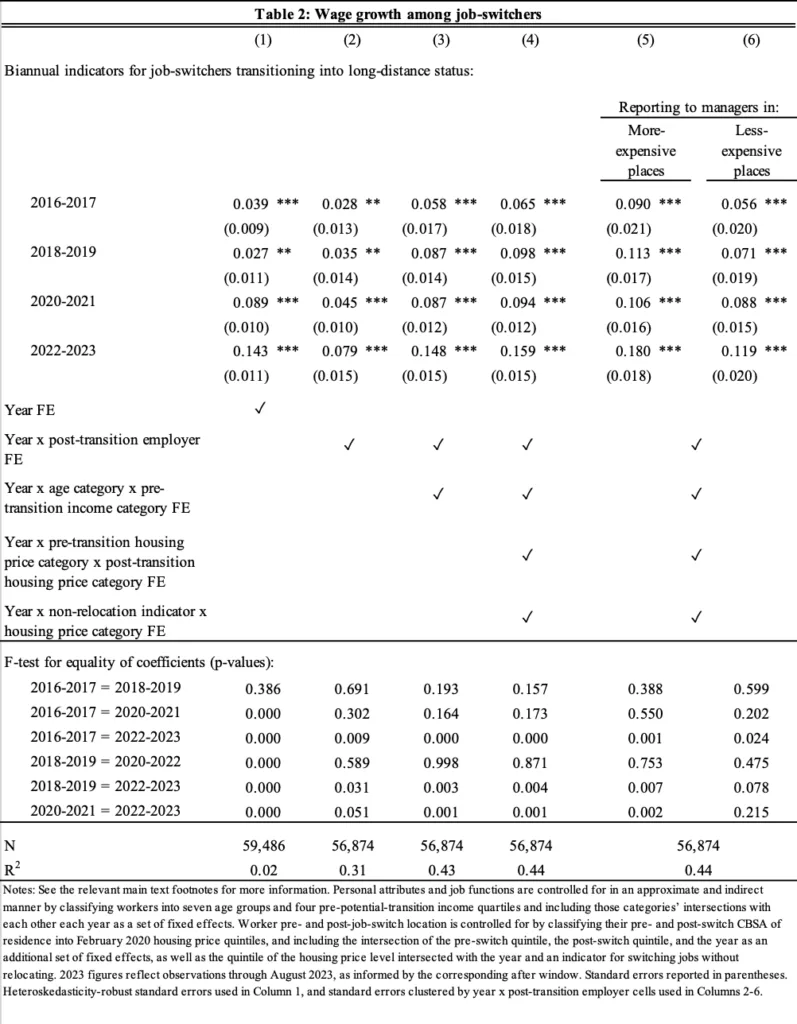
As with our job-stayers exercise, we used ADP data to track the gross wages of job-switchers who transitioned into long-distance work and compared their wages before and after the transition14. Unlike job-stayers, who generally transition into long-distance work by relocating, job-switchers can transition into long-distance work with or without relocating.
We compared the wage growth of job-switchers into long-distance work with that of job-switchers who took new positions locally with the same employers15.
Here, too, new hires can vary in terms of personal attributes such as age and income level, job function, and location. The tendency to transition into long-distance work can correlate with those factors, so we controlled for them to obtain a meaningful apples-to-apples comparison16.
Job-switchers hired into long-distance roles saw substantially greater wage growth than similar job-switchers who took local positions with the same employers.
Figure 2
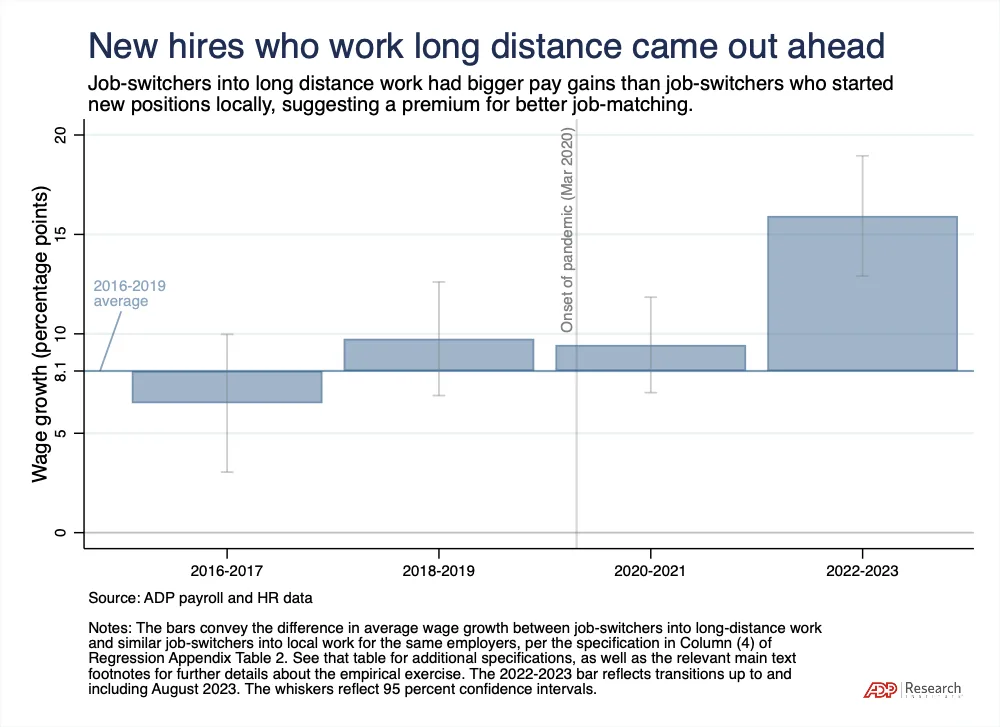
Since the pandemic, this gap has widened substantially. From 2016 to 2019, wage growth for people hired into long-distance work was more than 8 percentage points higher than for similar people who took on new jobs locally with the same employers17. By 2022-2023, the difference had risen to nearly 16 percentage points.
Why might the match between workers and jobs matter for pay18? Increasing the number and variety of job openings and candidates available—a thickening of the labor market— increases the potential for workers and employers to find better matches than they could otherwise19.
The explosion of long-distance work has significantly expanded the pool of jobs that applicants can consider and has enabled people to find better-matching jobs than they might otherwise. It also has helped employers find better candidates20. A better match ultimately creates value, which can manifest with improved productivity, greater job satisfaction, lower turnover, higher employer profits, and greater worker pay21.
And one worker-job match may be better than another because the applicant lives in a less expensive area and is willing to accept less pay. The post-pandemic jump in the wage growth differential of job-switchers into long-distance work can be attributed to geographic cost savings as well as better matching in a thicker market.
How might we separate the two? If the alternative to hire a long-distance worker is to hire locally, near the manager, then a long-distance worker-job match has the potential for geographic cost savings only when workers live in less-expensive places than their managers, not the other way around. If we examine job-switchers who take on long-distance roles reporting to managers in both more- and less-expensive places, any wage growth differential of the latter can be attributed only to better matching22. Figure 3 repeats the job-switcher exercise for those two groups23.
Figure 3
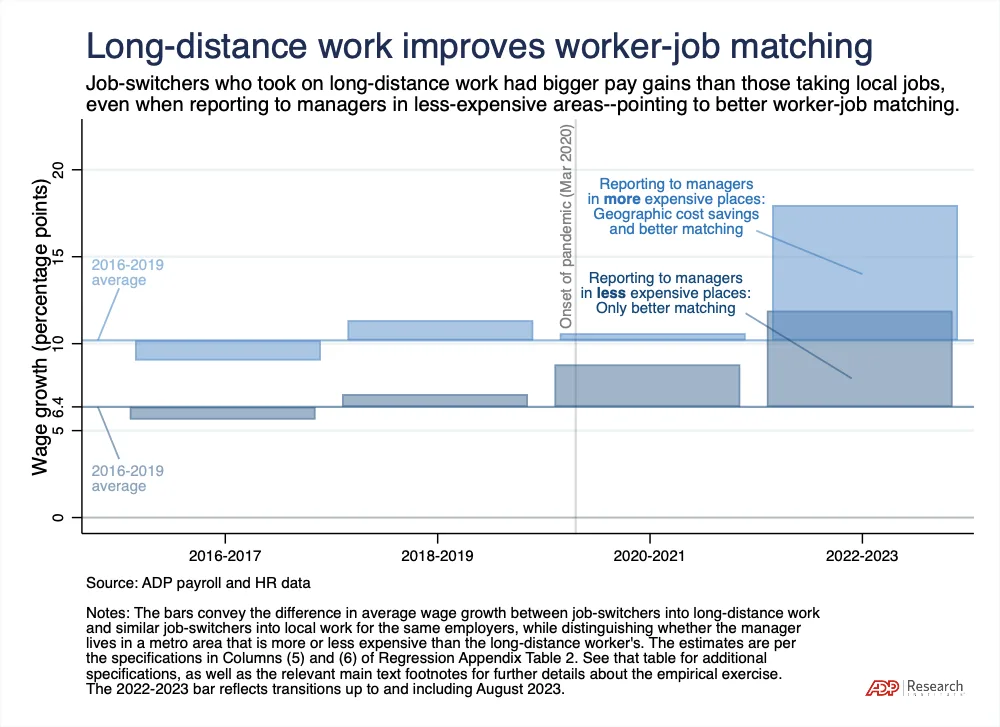
The wage growth differential for job-switchers taking long-distance work increased for both groups but was bigger for people reporting to managers in more-expensive areas. This result is consistent with that greater wage growth differential reflecting both geographic cost savings and better matching24.
Crucially, however, we also see an increase in the wage growth differential for remote job-switchers who report to managers in less-expensive places, where there are no geographic cost savings to be had. This higher relative wage growth suggests that long-distance work began producing better worker-job matches after the pandemic. The thickening of the market for long-distance work—the greater availability of non-local candidates and job openings due to the normalization of remote work—strengthened the match-quality advantage of long-distance work.
Looking ahead
Improved worker-job matching can benefit the economy and society because people who are in the right jobs tend to be more productive and satisfied25.
Long-distance work has its problems, including isolation and the challenges of remote managing, but its increasing prevalence suggests that the benefits outweigh the frictions2627.
As long-distance workers multiply and gain experience, new career trajectories might emerge. People could transition between in-person and long-distance careers, for example, the way lawyers move between partner- and non-partner career tracks, reflecting a trade-off between higher pay and better work-life balance.
And while both substance and presentation will continue to matter, long-distance work might lend itself to showcasing one’s work more prominently than one’s social skills, perhaps taking the market closer to meritocracy.
But as one of our previous studies noted, lack of proximity may come at a cost to society. The tremendous growth of long-distance work has turbocharged the process of domestic offshoring, which concentrates value-intensive jobs in the nation’s most expensive cities while sending rank-and-file ones to more affordable parts of the country. Inasmuch as opportunity depends on geographic proximity and interaction in-person, long-distance work that fuels domestic offshoring runs the risk of separating most Americans from opportunity by a barrier of distance. The many advantages of long-distance work may or may not be enough to surpass that barrier.
Regression appendix