



 5 min read
Issi Romem, Ph.D., Łukasz Below, Ph.D., Tim Decker, Liv Wang
As houses burned and businesses shuttered, the Palisades and Eaton fires also inflicted pain on workers.
The fires that swept through Los Angeles in January dealt a significant blow to local communities. While the areas that burned make up a small fraction of Los Angeles County’s total employment, the fires had far-reaching consequences as smoke, business disruptions, population displacement, and fear rippled across the region.1
In addition to the loss of homes, business, and infrastructure, the fires had an immediate impact on the labor market. Using ADP payroll data, we were able to measure the fires’ real-time impact on workers. We found that fewer workers received paychecks, and people put in less time at on the job compared to the same time last year.
Economic heavyweight
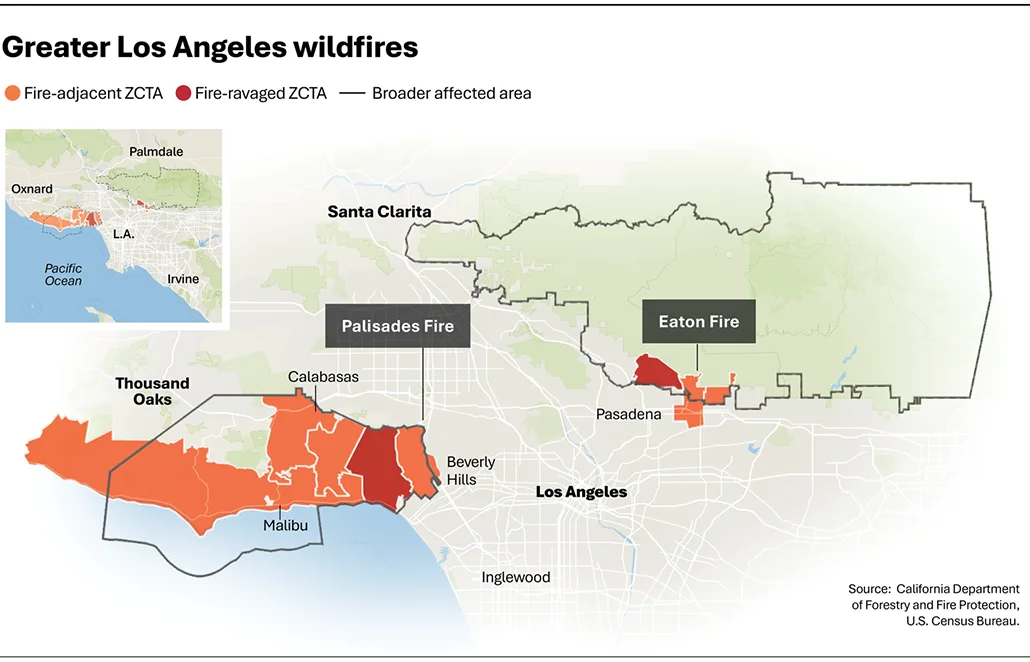
Greater Los Angeles is an economic powerhouse, but average and median incomes for Los Angeles County and the greater metro area align closely with the U.S. average and median.2Communities in and around the Palisades and Eaton fire zones each account for only about 1 percent of Los Angeles County employment, but these local economies stand out for their affluence.3 Median incomes in the Palisades Fire area are more than double that of Los Angeles County. In the Eaton Fire area, median incomes are nearly 75 percent higher than the county’s.
Palisades Fire
Communities in Palisades are particularly affluent, even by local standards; the median wage is 2.5 times that of Los Angeles County. Wages in fire-adjacent areas—those neighborhoods subject to mandatory or voluntary evacuations—are more than double the county median. But the fire-ravaged zone in Palisades accounts for only 0.2 percent of county employment.
Eaton Fire
In contrast to the Palisades Fire zone, median wages in fire-ravaged and fire-adjacent Eaton Fire areas are similar to the county’s.4 In the Eaton Fire zone, fire-ravaged areas account for 0.4 percent of Los Angeles County employment.
Real-time impact on pay
When we examined ADP payroll data to see whether the fires had a notable effect on labor market activity in January, we found a short-lived decline in the number of hours worked and paychecks issued, followed by a quick recovery.
The Palisades and Eaton fires began Jan. 7. When compared to the trajectory of paycheck issuance that week in 2024, there was a 10 percent gap in paycheck issuance in the same week of 2025 in ZIP codes most affected by fires. In other words, employers issued far fewer paychecks than we might have expected.
The following week, Jan. 12-18, the pattern was the same. The number of issued paychecks fell 6 percent compared to the same week in 2024. And the slowdown in paycheck issuance continued the week of Jan. 19-25, when it was down 10 percent from the 2024 reference week.
During the first two weeks of the fires, Jan. 5-18, the number of paychecks issued by employers in manufacturing was off by 3 percent and 6 percent. In healthcare and education, paycheck issuance was down 1 percent, then 10 percent.5
By the week of Jan. 26, the pace of paycheck issuance had returned to normal.
Real-time impact on hours
Weekly paid hourly workers in the Los Angeles-Long Beach-Anaheim, Calif., region also lost time on the job during the fires.
Average weekly hours fell 5.1 percent, or about two hours, in the week of Jan. 5-11 from the same week a year earlier. Hours worked dropped 2.6 percent, or 1.2 hours, the week of Jan. 12 compared to a year earlier.
In manufacturing, year-over-year average hours worked were down 6.7 percent the week of Jan. 5 . In trade, transportation and utilities, hours worked fell 5.9 percent that week and 8.9 percent the week of Jan. 12 compared to a year earlier.
As the fires destroyed homes and evacuations pushed people into hotels and restaurants, average hours worked in leisure and hospitality rose 1.4 percent year over year during the week of Jan. 5, and were up 2.8 percent and 2.9 percent in the following two weeks.
The road to recovery
The economic impact of the Palisades and Eaton fires extend beyond the immediate loss of jobs, homes, businesses, and infrastructure.
Displaced residents in need of housing could further strain an already expensive market and drive rent increases across the spectrum, cascading down market from luxury properties to more modest units, reshaping where people can afford to live. These effects could worsen an already challenging landscape for workers, pushing people farther from their jobs and into longer commutes.
While the Los Angeles region is likely to prove resilient, January’s fires drive home the vulnerabilities faced by even the wealthiest communities in an era of weather disasters. Of top concern: rebuilding in a way that sustains the region’s economic vitality, which is critical to California and the country, and seizes the opportunity to embrace modern fire-resistant construction and high-density development.