
 4 min read

Contributors:
Mary Hayes, Ph.D.
Director of Research, People & Performance
Jared Northup
Research analyst, People & Performance
Change is inevitable, but growth takes effort. In times of economic uncertainty, conventional wisdom tells us to learn new skills and adapt. But is education enough to get workers through a challenging labor market?
Data- and anecdotal-driven evidence suggests that today’s college graduates are finding it more difficult to land entry-level jobs, especially in fields exposed to advances in artificial intelligence. To learn how important education is in the minds of workers themselves, we asked people employed in 36 global markets if their education prepared them to land a job.
Only a small share said yes. But people with a college degree were more likely than those without to say their education prepared them for the workforce. They were more likely to feel they had the skills needed to advance in their career, more likely to report pay increases and promotions, and more likely to say they felt financially secure.
Our sample consisted of working adults, 68 percent of whom held the equivalent of an associate’s, undergraduate, or advanced college degree. This group included people at all levels of experience in jobs of all kinds.
The degree advantage
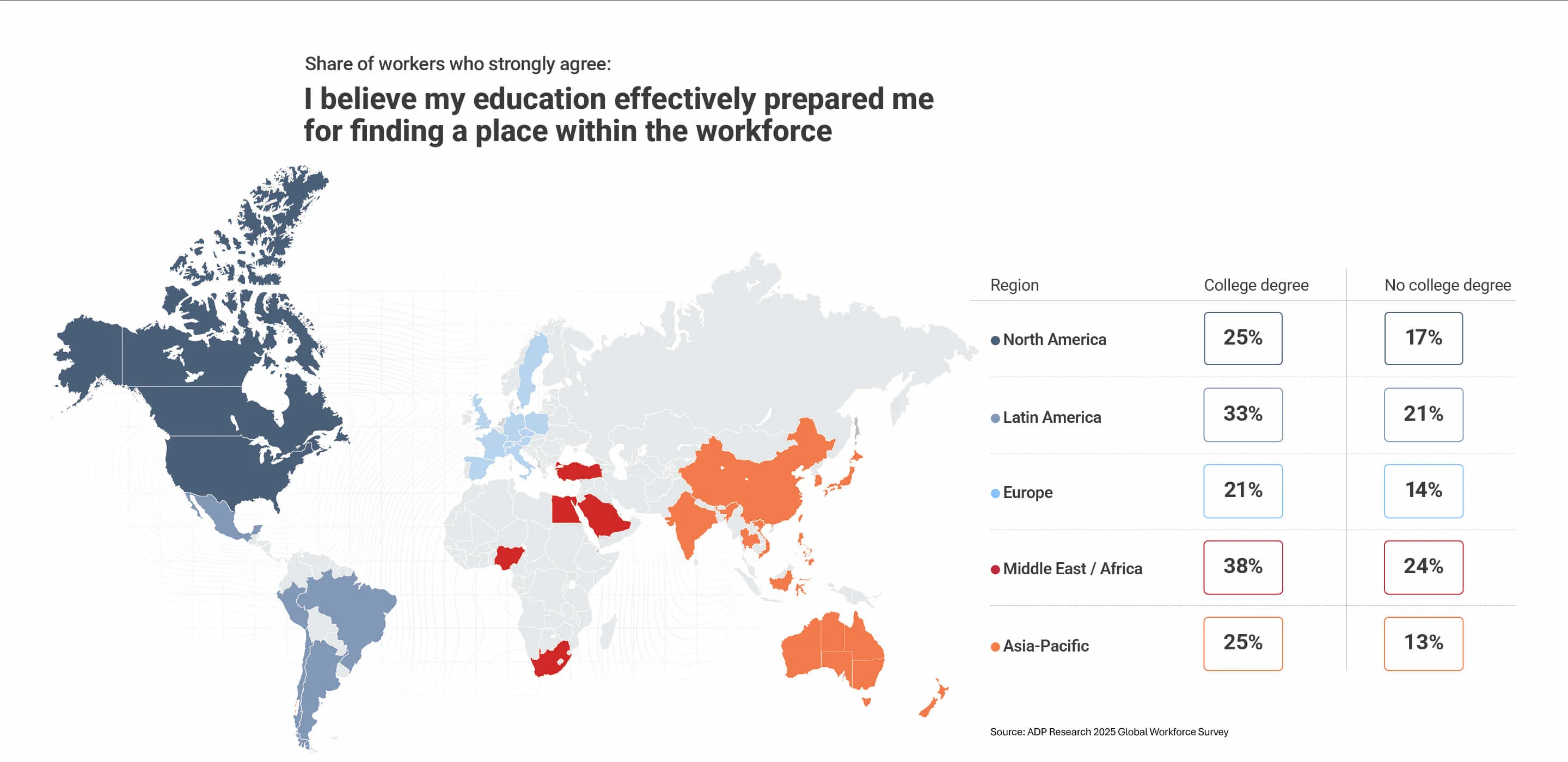
Only 24 percent of our survey respondents strongly agreed that their education prepared them to find a job. Among workers with a college degree, that number was 28 percent. And among people without a diploma, the share who felt their education had prepared them fell to 16 percent.
This education sentiment gap was widest in the Middle East/Africa. There, 38 percent of workers holding a degree said they felt prepared, compared to only 24 percent of those without a degree.
The United Arab Emirates was a big contributor to this regional divide. There, 35 percent of people with a degree felt prepared, compared to 14 percent of people without one.
In the Asia-Pacific region, the share of workers with a college degree who felt prepared was double that of workers without a degree.
Demographic comparisons
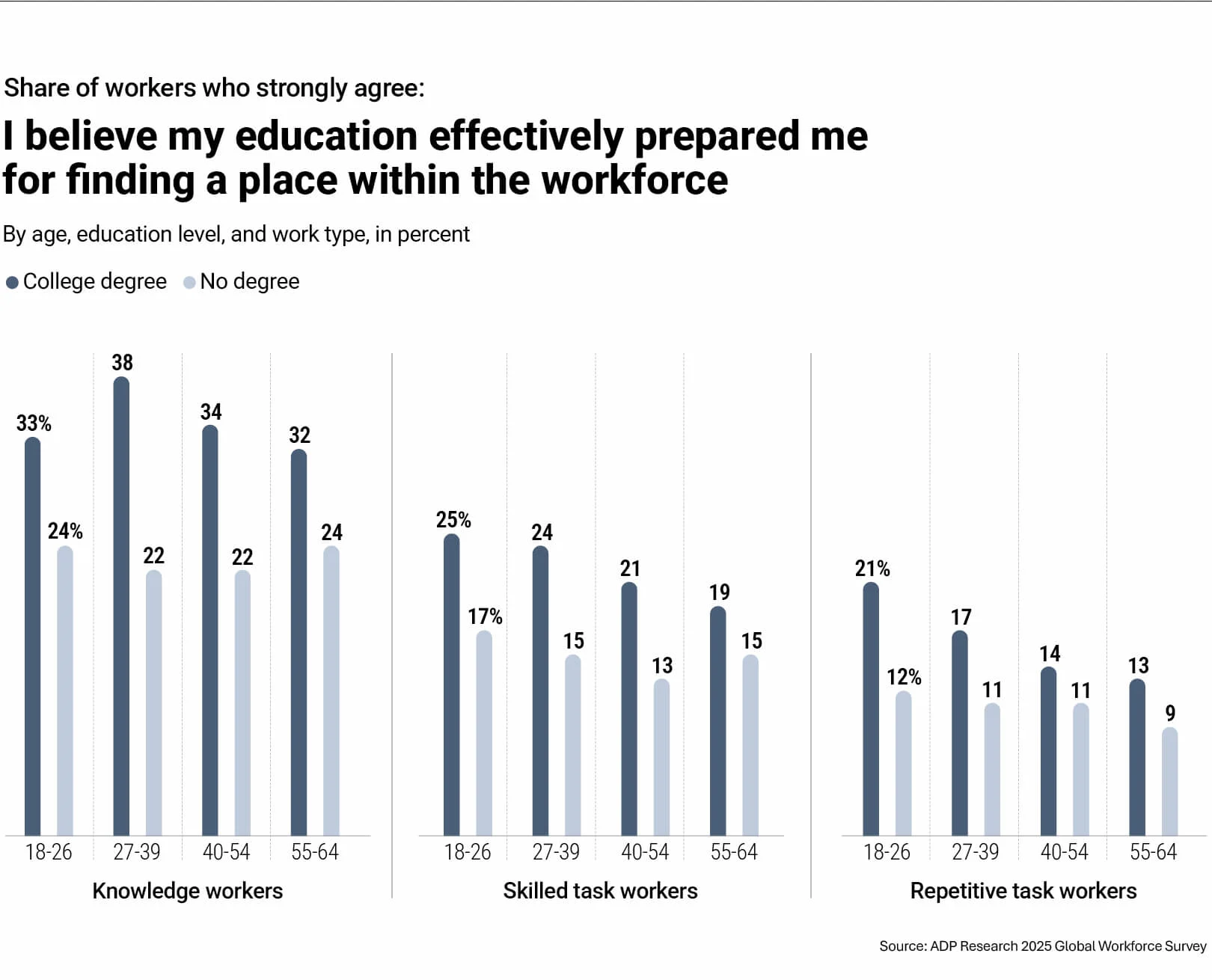
Our sentiment data showed little difference by gender. But when we compared answers by age and work type, responses varied dramatically.
Knowledge workers with a degree were by far the most likely to say they felt prepared.
For skilled task and repetitive task workers, feelings of preparedness dropped among older workers, regardless of whether they had a degree or not.
There were large variances by sector. Thirty-five percent of degreed workers in technology services and finance and insurance strongly agreed that their education effectively prepared them for the workforce, the largest shares of any sector. Compare that to degreed workers in arts, entertainment, and recreation and public administration, where the share was only 21 percent.
Knowledge workers with a degree were by far the most likely to feel prepared in every sector but agriculture, forestry, fishing, and hunting.
Education and skill development
Workers can feel insecure in their jobs when they think they lack the skills to advance. Respondents to our survey who were confident their education had prepared them were 9 times more likely to say with confidence that they have the skills needed to advance in their career.
And when workers feel they have the skills to advance, they feel substantially more secure in their jobs. People who strongly agreed that they have the skills needed to advance in the next three years were 5 times more likely to feel that their job is safe from elimination.
The takeaway
As the cost of education rises in many places around the globe, employers, policymakers, and workers themselves are debating the value of obtaining a college degree. But for educated workers in our global sample, the answer is clear: The diplomas they earned are paying off.
Workers with a degree were more likely to:
- have received a pay increase last year (56 percent compared to 47 percent of those without a degree).
- believe they’ll receive another raise next year (69 percent compared to 61 percent).
- report getting a promotion in the last year (46 percent compared to 33 percent).
- feel optimistic about receiving a promotion next year (44 percent compared to 32 percent).
- agree strongly that they have enough money to buy the goods and services they need (19 percent compared to 11 percent) and want (17 percent compared to 9 percent).
And there’s evidence that people who believe in the value of their education also are more ready for the next step in their careers. They feel they have a greater chance of advancing and are considering themselves financially secure.
In short, they’re ready for what’s next.
Methodology note
Educational levels were translated and adjusted to align with market-specific educational systems. Among OECD members, 40 percent of workers aged 25 to 64 hold a tertiary or college degree, but that share varies substantially by market.
By contrast, 68 percent of respondents to our global survey had some level of tertiary education, ranging from vocational training to advanced professional degrees.
Contributors:
Mary Hayes, Ph.D.
Director of Research, People & Performance
Jared Northup
Research analyst, People & Performance