

 4 min read
Contributors:
Mary Hayes, Ph.D.
Director of Research, People & Performance
Jared Northup
Research analyst, People & Performance
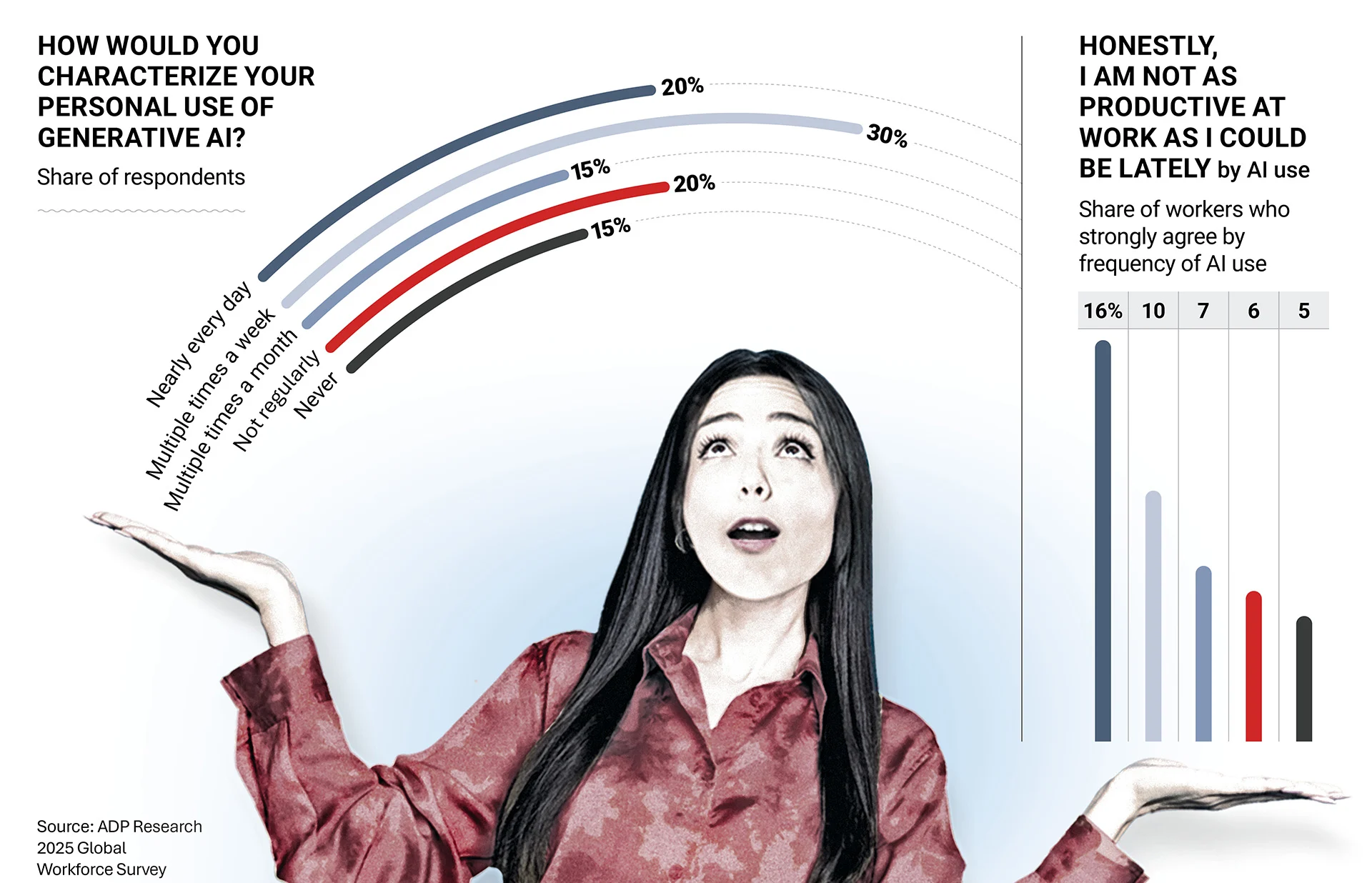
Generative artificial intelligence burst onto the scene in 2022 with the launch of ChatGPT and other user-friendly tools. Less than four years later, adoption is widespread. Half of workers we surveyed globally said they use AI at least multiple times a week. One in 5 said they use it nearly every day.1
As the effects of this rapid uptake ripple across workplaces, labor markets, and local economies, our 2025 Global Workforce Survey found some positive outcomes for workers, such as higher engagement and less stress. But it also revealed a gap between an AI promise and reality. Artificial intelligence, so far, hasn’t delivered on one of its biggest expected benefits: Workers who use AI don’t report feeling more productive.2
Who is using AI?
Young workers, men in particular, were the heaviest users of AI in 2025. But we found that attitudes toward the technology were shaped less by demographics than by familiarity.
Men, for example, were slightly more likely than women to believe that AI will improve their jobs, but this gender gap all but vanished among frequent users.
Similarly, while optimism about AI tended to decline with age, the difference narrowed sharply among daily users.
How is AI use affecting workers?
In our survey, frequent users of AI were more engaged, less stressed, and more positive about their teammates. But they didn’t necessarily feel more productive.
Engagement. Among people who use AI tools every day, 30 percent were fully engaged at work. But for workers who never use AI, engagement was less than half that, at 14 percent. As a whole, 19 percent of workers worldwide were fully engaged in 2025.
Stress. As AI use increased, fewer workers reported a high incidence of negative on-the-job stress. Only 11 percent of daily AI users were overloaded, compared to 23 percent of non-adopters.3
Teams. People who use AI more frequently were more likely to report being part of a work team. This is important, because our data has shown a strong connection between team membership, higher engagement, and lower stress. What matters even more is feeling that you are on the best team. The more people use AI, the more likely they were to report being on the best team.
Productivity. Our research has long established that engagement, stress, and teams can influence productivity. But while heavy AI users showed higher engagement, less stress, and more positive feelings about their teams, they also said they felt less productive. In fact, daily users of AI were four times as likely as non-users of AI to say they were less productive than they could be.4
While we have no way of measuring the actual productivity of these workers, it’s possible that the more people use AI to get their work done, the more it feels like they’ve accomplished less than they might have. Productivity might in fact have increased, but people might perceive that they are doing less of the work themselves.
How will AI affect jobs?
That’s something we can’t predict. What we can say is that as the frequency of AI use increased, workers were more likely to say with confidence that their jobs were safe from elimination.
Even so, young workers, including frequent users of AI, are less optimistic about their job security. This sentiment aligns with Stanford Digital Economy Lab research showing that the adoption of AI technology is in fact linked with slower job creation among young workers in some sectors.
The takeaway
As AI makes its way into the workplace, organizations could benefit by helping their employees become more familiar with the technology and encouraging its use, where applicable. Unknowns abound, but our data suggests that AI presents itself to many people as a teammate, one that might help workers feel more engaged and less stressed on the job.
For more on this story, including market-by-market data, please see Today at Work 2026, Issue 1.
Contributors:
Mary Hayes, Ph.D.
Director of Research, People & Performance
Jared Northup
Research analyst, People & Performance