



 4 min read
Nela Richardson, Ph.D.
International organizations and non-U.S. statistical agencies have long used private-sector data such as supermarket point-of-sale information, bank transactions, and online prices to learn more about the economy.
A new paper presented at the March 6 U.S. Monetary Policy Forum at the University of Chicago now reveals the power of private-sector data to complement U.S. government statistics on payroll growth and inflation, information that can be used to help the Federal Reserve meet its dual mandate of full employment and price stability.
Using payroll data from ADP, income and hiring data from Vanguard, and checking account transactions from JPMorganChase Institute, Private Canaries: The Value of Private-Sector Data for U.S. Monetary Policy Making finds that private-sector data can be a reliable tool for economists, market analysis and policy makers as they gauge the paths of employment and inflation.
More specifically, the paper found that private data on employment, incomes, and consumer spending could help predict the first and third prints of the Bureau of Labor Statistics’ monthly non-farm payroll release – the government’s closely watched monthly jobs report – and anticipate the bureau’s core Consumer Price Index, an important measure of inflation.
This power to reduce statistical noise and deliver an early signal of changing economic conditions could have ramifications for the Federal Reserve. Using the summer of 2025 as a case study, the paper suggests that information in private-sector data might have justified an earlier 25 basis point cut in the Federal Reserve's target federal funds interest rate.
ADP National Employment Report historical simulation data used in the report can be accessed at ADP National Employment historical simulation data.
My take
Companies have long mined their internal administrative data to inform business decisions. Now more of them are making this information available to the public.
Policymakers are paying attention for two reasons, according to the paper. First, many U.S. indicators, including the flagship non-farm payrolls report, are built on surveys of households and businesses. Declining response rates have made these series less precise.
Second, in times of critical uncertainty and economic shock, timely, granular, and sometimes non-traditional data is required. As the coronavirus pandemic revealed, such crises can give rise to new questions that are difficult to answer with official statistics. Furthermore, both the pandemic and the 2025 U.S. government shutdown disrupted the production and release of official data altogether.
No single data set can completely capture all the attributes of a fast-moving and complex economy. But private-sector data are useful complements to government statistics. They can widen our aperture with real-time, granular signals of the direction of the economy.
Main Street Macro will be on hiatus next week. The NER Pulse will publish as scheduled on March 17, and I’ll be back March 24 with a fresh take on the economy and labor market.
The NER pulse
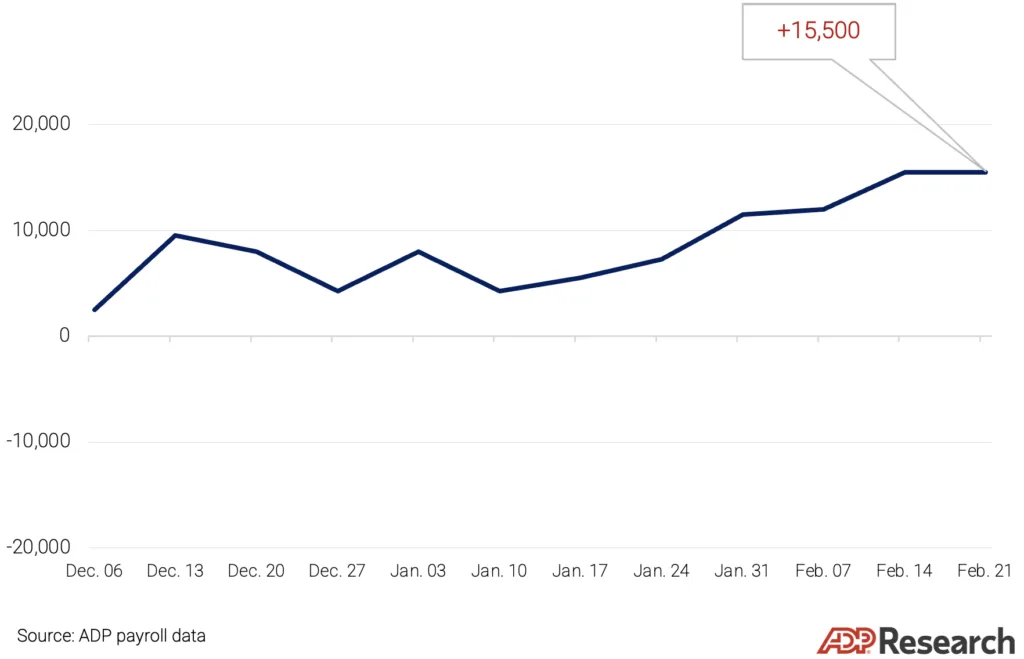
For the four weeks ending February 21, 2026, private employers added an average of 15,500 jobs a week. Employment held steady in February after five straight weeks of strengthening. These numbers are preliminary and could change as new data is added.
Download this week’s NER Pulse data.
The week ahead
Tuesday. After oil broke $100 a barrel for the first time since 2022, the stream of economic releases this week could be even more backward-looking than usual.
Mortgage rates are at their lowest levels in four years, which might boost February data on existing home sales, due Tuesday from the National Association of Realtors. January sales fell 4.4 percent from a year earlier.
Wednesday. The BLS Consumer Price Index for February won’t capture the effect of the recent surge of energy prices. While the index remains an important indicator of consumer health, economists likely will pay less attention to this month’s release.
Thursday. Economists will be watching whether initial jobless claims from the Department of Labor continued to hover near historical lows after unexpected job losses reported by the BLS last week. Residential construction data on starts and permits from the Census Bureau will give an indication whether we can expect an uptick in supply later this year to help thaw the housing market.
Friday. To round out the week, the Bureau of Economic Analysis publishes an update on fourth-quarter GDP as well as a delayed but critical look at January’s Personal Consumption Expenditures Price Index, the Fed’s preferred inflation measure.We’ll also get data on January job openings from the BLS and the latest University of Michigan consumer sentiment survey.
ICYMI. ADP Research partnered with Bloomberg’s Wall Street Week on a look at the labor market dynamics behind the AI-driven boom in data center construction. Can the workforce keep up with this rapid expansion? Watch the segment.https://urldefense.com/v3/__https:/www.youtube.com/watch?v=dILPnV20JFA&list=PLGaYlBJIOoa9ubuZWkdlPKN-XGVvWGlBe&index=2__;!!L8-7AA!WRV9bkrkVCCazdenhRSY9d2KBXOMrKHAJJIlHMNR5Ma889vqcATaImFy0QOil2nVLA34RuQBTExNfW7Pq0ZjHSjyKvI$