



 6 min read
Nela Richardson, Ph.D.
One classic conundrum of economics is the principal-agent problem. Principals want a task done but lack the know-how, time, or energy to do it themselves. Agents are capable of doing the work, in theory, but they might not do it exactly the way the principal wants.
Enter the incentive. In economics, incentives align the work of agents to the will of principals. They can be positive or negative, financial or social. In the workplace, incentives commonly take the form of salary and performance-based pay—the annual bonus. Employers award bonus pay tied to measurable attributes of performance as a way to attract and retain workers.
But bonuses aren’t what they use to be. And ADP Research has found that money isn’t the only motivator when it comes to employee loyalty and productivity.
The disappearing bonus
Total compensation costs to employers, including wages, bonuses, and benefits, rose 0.8 percent during the three months ending in September, slowing from a 0.9 percent increase in the prior quarter, according to the Employment Cost Index from the Bureau of Labor Statistics.
This quarterly increase represents year-over-year wage and bonus growth of 3.6 percent for the second straight quarter. This pace of growth is slower than the peak 5.6 percent year-over-year change we saw in the spring of 2022, when wages and bonuses soared as employers hired en masse to replace workers who quit or were laid off during the pandemic. But compensation costs historically have grown at less than 3 percent annually.
The BLS quarterly report on compensation provides data on wages, benefits, and bonuses, but doesn’t break out the latter. To ascertain whether bonuses or wages are growing faster, we can turn to ADP payroll data.
When we analyzed the anonymized payroll records of some 12 million private-sector workers from 2019 to 2024, we learned that bonus pay is becoming less common. The share of U.S. workers receiving a bonus in 2024 was 39.7 percent, down from a peak of 43.7 in 2021, when employers were racing to find and retain workers during the Great Resignation.
Employers aren’t frantically competing for talent these days. Fewer workers are quitting, and hiring has slowed.
In December 2024, year-over-year pay growth was 4.6 percent for job-stayers, which we define as people working at the same employer as they had 12 months earlier. During that same period, bonus pay grew by only 1.3 percent.
Money isn’t everything
For more than a decade, we’ve been collecting data on what—besides money—motivates employees.
The ADP Research Employee Motivation and Commitment Index tracks how people think and feel about their jobs and employers. Each month, this panel survey gathers responses from a stratified, random sample of 2,500 U.S. workers.
The EMCI Index captures what drives worker loyalty and productivity, aggregating responses across sentiment categories. In essence, the findings boil down to a single word: trust. Trust in a company’s future, trust in management, trust in one’s team, and trust that one’s work will be recognized (perhaps in the form of a bonus).
As bonus pay was slowing in 2024, the EMC Index showed that employee sentiment was on the rise and had exceeded levels set before the Great Resignation. Sentiment has continued to soar in 2025.
Employee sentiment was high not only in the United States. Globally, employee engagement has remained at a record high set in September 2024 as economies worldwide experienced lower unemployment and more job security than in the past decades.
During the pandemic, employers reinvested in their workforce, focused on health, both physical and mental, and adopted widespread remote and hybrid work options. These changes seem to have contributed to an upward shift in employee motivation and commitment.
More recently, employee sentiment has been edging down as other measures of the labor market, such as hiring, have weakened.
My take
At first blush, bonus payments are an easy-to-execute solution to the labor market’s most basic economic conundrum, the principal-agent problem, or how to achieve maximum productivity.
Yet, when bottom lines are squeezed and hiring slows, we found that bonuses aren’t as readily available to prod workers into working optimally.
And while incentive pay might lead to more productive employees, it doesn’t always inspire loyalty or commitment. We witnessed this during the Great Resignation, when people quit in record numbers despite record pay incentives.
What’s an employer to do? Well, our research shows that trust is another currency that motivates and incentivizes the workforce.
When workers feel that their employer is moving in the right direction, when they see that their contributions are recognized, and when they feel supported by their teams, the principal’s will and agent’s work align in a way money can’t buy.
THE NER Pulse
For the four weeks ending Nov. 29, 2025, private employers added an average of 16,250 jobs a week. This continued strengthening during the second half of November signals a rebound in hiring after four weeks of job losses. These numbers are preliminary and could change as new data is added. Download this week’s NER Pulse data
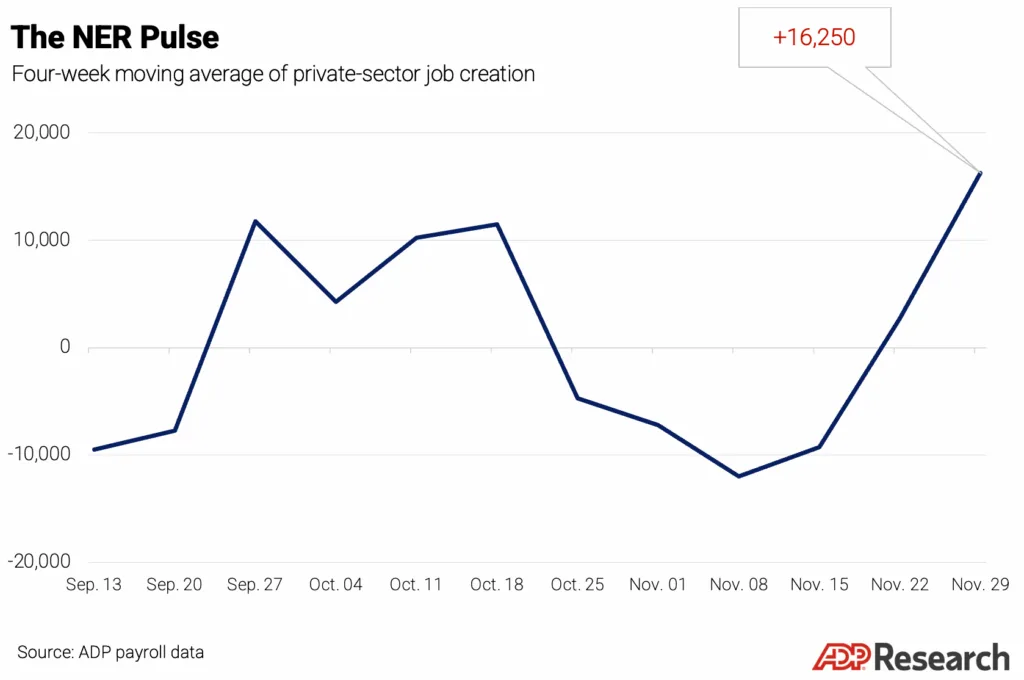
Three times a month, Main Street Macro releases the NER Pulse, an estimate of the week-over-week change in employment based on a four-week moving average. These releases are seasonally adjusted and have a two-week lag to allow for more complete and accurate estimates of real-time employment trends. At the beginning of each month, we publish the National Employment Report, which is built on a reference week that includes the 12th day of the month. We do not publish the NER Pulse during NER release weeks.
Note: The NER Pulse won’t publish Dec. 30 because the week ending Dec. 13 corresponds to the reference week of the monthly National Employment Report. The next NER Pulse will be released Jan. 13, 2026
The week ahead
Monday: The National Association of Home Builders/Wells Fargo Housing Market Index kicked off this data-filled week. Even with mortgage rates near 2025 lows, builders are cutting prices and confidence remains in contraction territory.
Tuesday: The Bureau of Labor Statistics releases delayed October and November non-farm payroll reports. After September’s 4.4 percent unemployment rate, I’ll be watching the November unemployment for signs of increased fragility or stability. The ADP Research EMC Index for December also publishes today.
Thursday: November’s Consumer Price Index will show whether price increases have slowed, sped up, or stalled since the BLS reported 3 percent annualized inflation in September. Any of these three scenarios are fair game.
Friday: The week ends with existing home sales data from the National Association of Realtors, which will tell us whether lower mortgage rates lured homebuyers off the sidelines in November.
The NER Pulse will publish in this space next Tuesday, Dec. 23, but Main Street Macro will be on hiatus until next year. The NER Pulse will not publish Dec. 30. Sending warmest wishes for the new year to all my readers.