



 4 min read
Nela Richardson, Ph.D.
Three recent data trends help explain where the U.S. economy stands today: Wage growth has stabilized below the rate of consumer inflation, entrepreneurs continue to start businesses at an impressive pace, and unemployed workers are taking longer to find their next job.
Together, these signals point to an economy that’s increasingly relying on productivity, innovation, and business formation – rather than labor-market tightness – to drive growth.
Wage growth isn’t driving inflation
Inflation concerns have resurfaced, but the labor market isn’t the primary source of price pressure.
Pay Insights data from ADP Research shows that the slow pace of U.S. wage growth has become even more pronounced over the past year. That means paychecks can’t be blamed for chasing prices higher.
In September, year-over-year median base pay growth was 3.2 percent, near the lowest pace of the current expansion. The last time annualized pay growth exceeded 3.4 percent was in October 2025.
For workers who stayed in their jobs, year-over-year pay growth has been at 3.0 percent in every month this year. Among job-changers, pay rose 4.8 percent. That job-changing premium remains well below the outsized pay gains workers captured during the tight labor market of 2022 and 2023.
With consumer prices rising 3.7 percent in September, workers who changed jobs saw only modest real wage gains, while many job-stayers likely lost purchasing power.
The labor market is still rewarding mobility, but far less generously than it did just a few years ago.
America's startup boom still has legs
More than a year ago, Main Street Macro highlighted one of the most surprising economic stories of the post-pandemic era: Americans were starting businesses at a breakneck pace. The question then was whether the startup surge would fade as higher interest rates, tighter credit, and a cooling economy took hold.
So far, the answer is no.
Census Bureau Business Formation Statistics show that entrepreneurs still are stepping up. They filed 534,947 new business applications in September, an increase of 0.5 percent from August and 4.4 percent from a year earlier.
Applications that are likely to become employer businesses, known as high-propensity applications, rose 1.3 percent month over month and 3.1 percent from a year earlier, while applications that include plans to hire workers increased 4.3 percent from August.
There’s one important caveat. Even after September's increase, business applications with planned wages remain 6 percent below year-ago levels, suggesting entrepreneurs remain cautious about adding employees.
The labor market has a hidden weakness
The unemployment rate remains low by historical standards at 4.2 percent, and layoffs continue to run below levels typically associated with an economic downturn. On the surface, the labor market looks healthy.
But beneath the headline numbers, a cautionary trend is emerging: Unemployed workers are taking longer to find their next job.
In September, 1.9 million people had been unemployed for 27 weeks or longer, a group that accounted for 27.1 percent of all unemployed workers, according to the Bureau of Labor Statistics. That's up from 24.7 percent a year earlier. The share of unemployed workers experiencing long spells of joblessness has hovered around 27 percent for much of 2026, remaining above year-earlier levels.
Workers who lose a job are increasingly likely to face a longer search before finding another one.
My take
Taken together, these Main Street data points are signaling caution and a changing source of growth.
Pay isn’t an inflation trigger, employers are hiring more selectively, and entrepreneurs in growing numbers are starting lean. But with business formation still strong and projected employer startups up 4.3 percent from last year, Main Street continues to position itself to create the next generation of jobs.
Main Street Macro will be on hiatus next week. The NER Pulse will publish as scheduled.
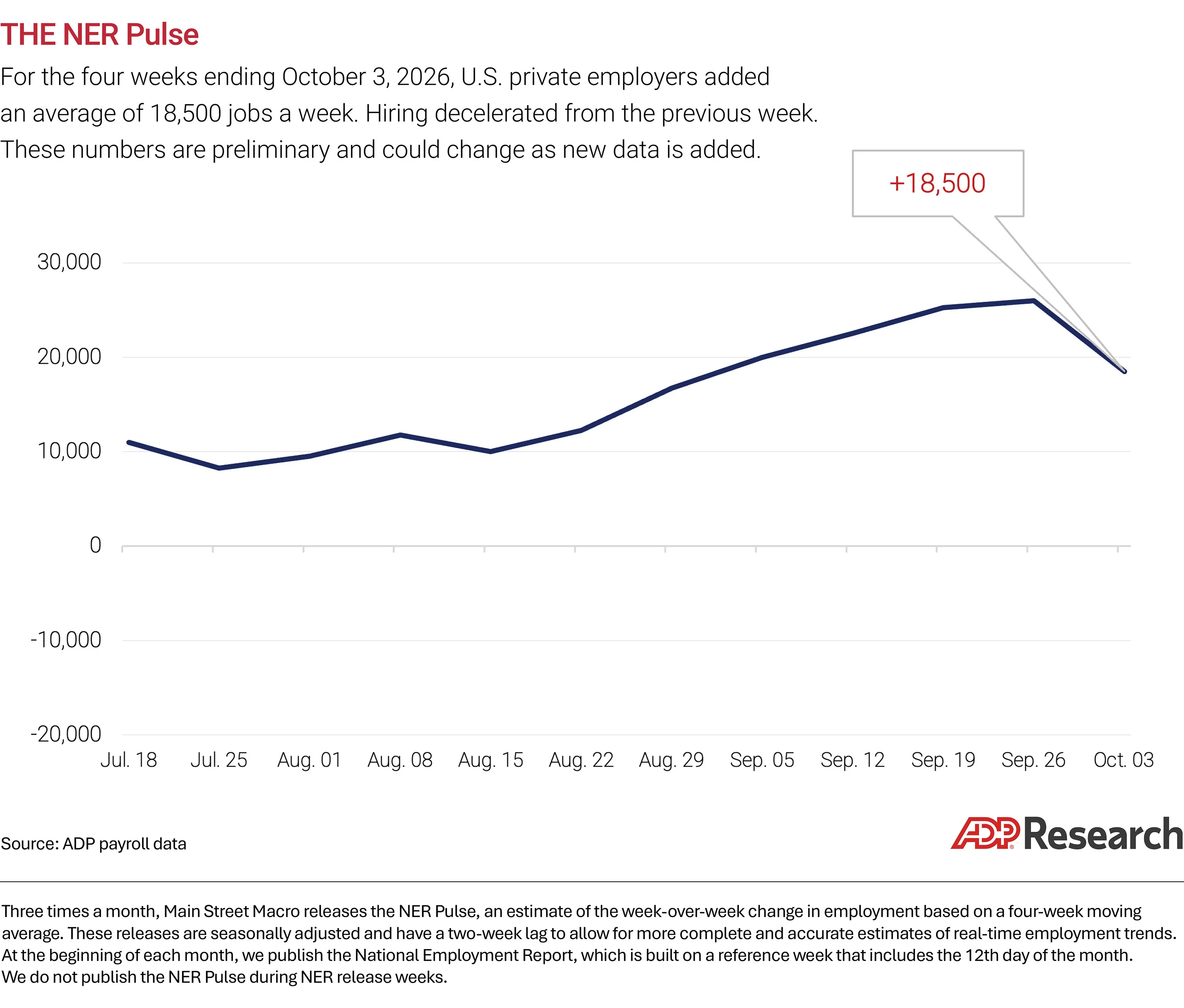
Download this week’s NER Pulse data

The week ahead
Tuesday. August housing starts for new single-family homes and apartments were down more than 1.2 percent than a year ago. I’ll be watching if rising interest rates added further strain on the pace of residential construction in the September report from the Census Bureau.
The ADP Research Employee Motivation and Commitment Index, which tracks how U.S. workers think and feel about their jobs, added four points to close at 131 in October.
Wednesday. The Canaries Dashboard, a project of ADP Research and the Stanford Digital Economy Lab, releases September data on AI’s effect on more than 700 occupations.
Thursday. Initial jobless claims have trended near historical lows for the lion’s share of five years now. And no news is good news when it comes to this consistent indicator of labor- market stability from the Department of Labor.
Friday. The S&P Global monthly Purchasing Manager’s Index has shown a recent boom in business growth, yet price growth could prove to be a constraint. I’ll be watching the pressure gauge on indicators of manufacturing and services growth. We’ll also learn if there’s any improvement in the consumer mood when it comes to business conditions when the University of Michigan reports its final sentiment measure for October.