



 5 min read
Nela Richardson, Ph.D.
It’s summer, and that means one thing for the labor market: An influx of young workers.
In any typical month, people between the ages of 15 and 24 account for about 30 percent of new hires, according to ADP payroll data. But in June, that share jumps above 40 percent.
Summer hiring, be it in retail, leisure and hospitality, or local services, pulls young adults into the labor force in numbers that are unmatched in any other time of year.
This seasonal surge shows up in two important ways. First, participation rates for teens rise as school lets out and more young people start looking for work. Second, unemployment rates can move higher — not because the labor market is weaker, but because more inexperienced workers are actively searching for jobs at the same time.
The labor market typically is both more dynamic and more volatile in summer than during any other time of year. But this June, wage growth for young workers has normalized.
Age matters
When you step back from the month-to-month noise to look at the big picture, differences in unemployment by age are striking and remarkably persistent.
Across the full historical record, which dates back to 1948, the average June unemployment rate for people aged 16 to 19 is about 16 percent, according to the Bureau of Labor Statistics. For young adults between the ages of 20 and 24, it’s closer to 9 percent. And for prime-age workers, those between 25 and 54, it drops to less than 5 percent.
That means even in the best of times, teens face an unemployment rate that’s more than three times higher than that of prime-age workers. And young adults experience roughly double the unemployment rate of older workers.
This disparity reflects structural differences in experience, job stability, and the way younger workers move in and out of jobs. Teens are more likely to be entering the labor force for the first time, are more likely to take temporary or seasonal positions, and are more likely to be sensitive to changes in hiring demand.
The pandemic shock
The pandemic put these differences into focus, and the recovery tells an even clearer story.
In June 2020, teen unemployment jumped to nearly 22.5 percent, up from 12.6 percent a year earlier, before the pandemic began. The jobless rate for young adults in June 2020 was 19.6 percent, up from 6.1 percent a year earlier.
What’s striking is the difference in how these two groups recovered.
Teens bounced back quickly. By June 2021, their unemployment rate already had fallen to 11.2 percent, comfortably below its pre-pandemic level. For young adults, the recovery took much longer. It wasn’t until June 2023 that their unemployment rate finally returned to its pre-pandemic benchmark of 6.1 percent.
The post-pandemic recovery
If 2020 was the shock and the next couple of years were the rebound, the period since has been more nuanced.
In June 2022, teen unemployment reached a post-pandemic low of 11 percent. Instead of staying there, it has gradually climbed. In June 2025 and June 2026, the unemployment rate for teenagers was 14.5 percent and 14.6 percent, respectively.
In other words, teen unemployment for June is at its highest level in a decade, outside of the pandemic years. This trend suggests that while the labor market remains broadly healthy, conditions for younger workers have softened relative to the early post-pandemic years.
Labor force participation during this period has told a slightly different story. Teen participation edged higher, peaking at 37.3 percent in June 2024 before settling closer to the mid 30-percent range in more recent years. So even as unemployment has risen, teens haven’t pulled back from the labor market. They’re still participating, they’re just facing a tougher environment.
Summer wages
June is the most important month for teen and young worker labor dynamics because it captures the busy intersection of the school-year’s end, summer hiring, and a surge of inexperienced job- seekers.
Hence, these jobs tend to pay less. The median wage for workers aged 16 to 24 is typically below $17 an hour, compared with $20 or more for older cohorts.
The wage story, however, has shifted. Pay growth for newly hired teen and young workers accelerated in 2021 and 2022, with the year-over-year change topping 10 percent as employers competed for scarce labor.
But that momentum faded quickly. By 2024, pay growth for this group had slowed sharply, and by 2025 it had flattened. This year, year-over-year pay growth in June returned to a robust and durable pace of 3.7 percent. The pattern contrasts with the more stable pay growth of new hires aged 25 and older.
This divergence tells an important story: The early post-pandemic period delivered outsized gains for young workers, but their pricing power has since diminished. The summer labor market is still active, but the wage premium that defined it a few years ago has normalized.
My take
I think about my own first summer job at a pizza place filled with high school friends. The perks were obvious: free food, social capital, and a sense of independence. But the downside was just as clear: irregular hours and unpredictable pay.
My next job, at a library, was the opposite. Less exciting, maybe, but far more stable. The hours were consistent, the pay was predictable, and the structure made it easier to plan ahead. What I lost in points for coolness I gained in reliability. Over time, I realized that predictability is its own form of value. Already I was an economist in the making.
That’s what the data are pointing to as well. The labor market for young workers is still defined by volatility, even in a period of overall strength. And while summer always brings a burst of opportunity, it also underscores how uneven that opportunity can be for young entrants.
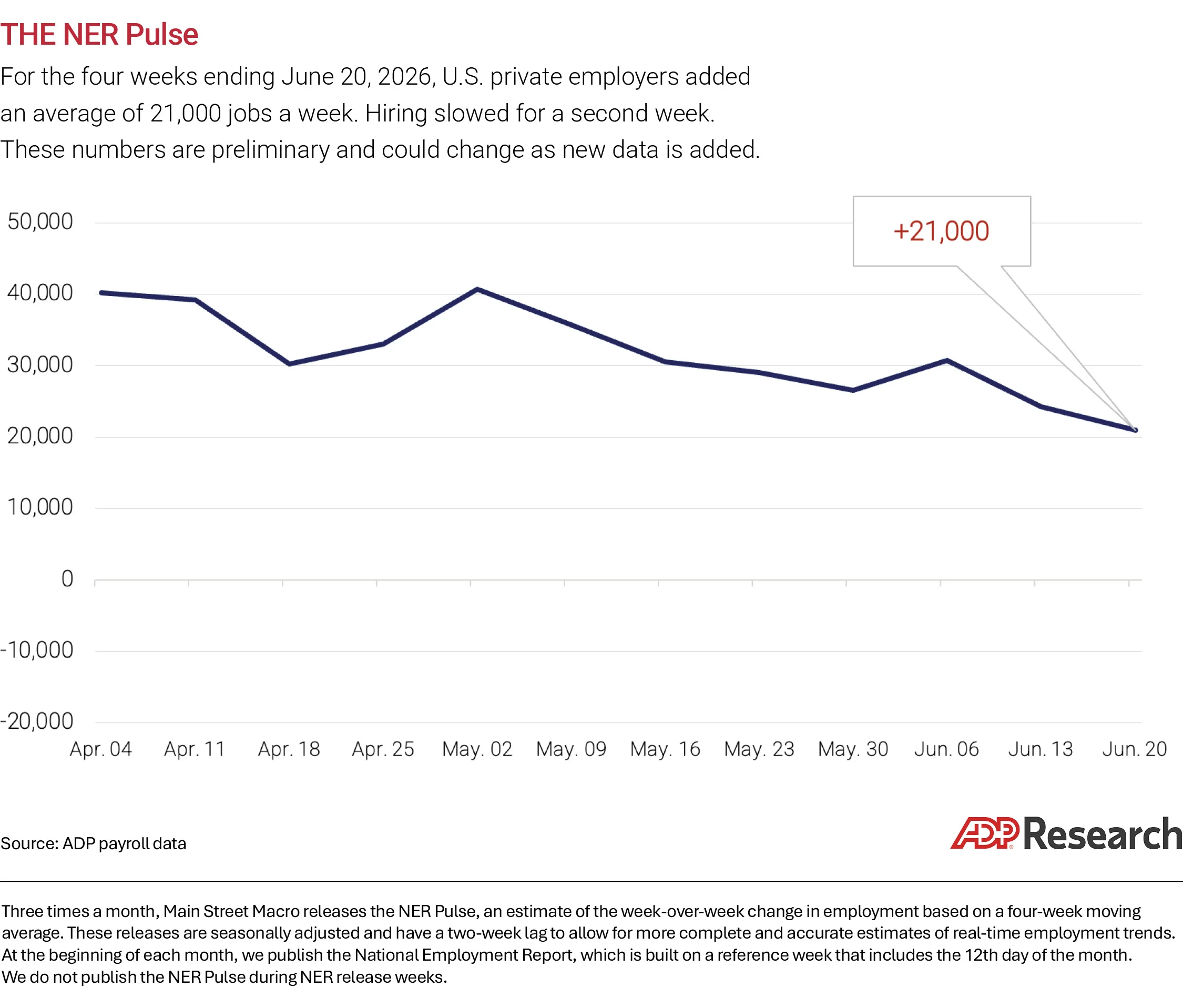
Download this week's NERP Pulse Data.

The week ahead
Wednesday: It’s a big day for demand signals. Inventory data from the Census Bureau will help us gauge whether businesses are beginning to restock or remain cautious. Economists and market-watchers will parse Federal Reserve minutes for tone, especially if there’s any shift in the balance of risk between inflation and labor market weakness. And consumer credit data from the Fed will deliver a direct read on household behavior, telling us whether households are borrowing to sustain spending.
Friday: The week closes with existing home sales data from the National Association of Realtors, where the story is likely to be familiar. Housing is still the most rate-sensitive part of the economy, and economists will want to see if the market continued to edge up in June as mortgage rates fell, or whether it drifted lower under the weight of affordability constraints.