



 4 min read
Nela Richardson, Ph.D.
October's employment reports showed once again that American employers are still hiring. Payroll growth exceeded expectations; unemployment remained relatively low, and layoffs continued to run below levels associated with economic downturns.
However, there’s one area where the labor market has been falling short: Dynamism. In a healthy labor market, talent is mobile, flowing to the most productive areas of the economy.
For much of the post-pandemic recovery, Main Street Macro has focused on the emergent Great Stay, or job-hugging, the growing tendency of workers to remain in their current job rather than pursue opportunities elsewhere.
Yes, workers value job security, but in a healthy market, confidence and opportunity influence people to search for and secure new jobs. Today’s falling quits, slower job-to-job transitions, and declining labor-market mobility point to something different: Keeping a job has become much easier than finding one.
Stability takes the lead
The chart below tells part of that story. September, like January, is a standout month for workforce moves, as summer and holiday seasonal workers transition to long-term employment.
For the past decade, September turnover rates have been remarkably stable and mostly above 6 percent. After rebounding after the pandemic, turnover has moved toward the lower end of its recent range.
This year, the pace of September turnover was roughly 5.8 percent, one of the lowest readings outside the pandemic shock itself.
Hidden costs
For decades, economists have shown that labor-market dynamism – that is, the ability of workers to move between employers, industries, occupations, and regions – plays a critical role in wage growth, productivity gains, and career advancement.
When turnover slows, these pathways narrow. Increasingly, the evidence suggests that people on the outside are feeling the effects.
The share of workers experiencing long spells of unemployment has grown in recent months. The number of people unemployed for more than six months was up 7.1 percent in September from a year earlier, and the share of the long-term unemployed has eclipsed its three-year average of 22.4 percent, growing to more than 27 percent for three consecutive months, to 27.6 percent in October.
That’s the largest share going back to December 2021, when the labor market was still reeling from pandemic job losses.
A narrower entryway
The slowdown in turnover is widespread across industries. But the biggest deceleration shows up in industries that function as important entry points into the labor market, such as education leisure and hospitality, and professional and business services.
Historically, these sectors have welcomed large numbers of new entrants, including recent graduates, career-changers, and returning workers. When turnover slows in these gateway industries, hiring opportunities can narrow even when employment remains healthy.
Early-career access
The Canaries Dashboard, a project of the Stanford Digital Economy Lab and ADP Research, shows that hiring has weakened most noticeably among early-career workers in occupations exposed to artificial intelligence. Much of the discussion understandably focuses on AI itself.
But labor-market dynamics might be contributing to this phenomenon, too. Consider how career ladders traditionally work. A senior analyst becomes a manager. A manager becomes a director. An entry-level position opens.
Now imagine a low-hire, low-fire labor market. Workers occupy their roles for longer periods of time. Promotions happen less frequently. Vacancies emerge more slowly.
Entry-level openings become more scarce. From this perspective, declining early-career hiring might reflect more than AI substitution alone. It might also reflect reduced access to the labor market.
My take
The Great Stay has delivered an undeniable benefit: historically low layoffs and stability for workers who already have jobs.
But stability comes with a hidden cost. As workers hold onto jobs longer, opportunities circulate more slowly. A healthy labor market does more than create jobs. It creates opportunities.
For much of the past two years, economists have debated whether the labor market is cooling. The more important question might be whether the labor market is becoming harder to enter in the first place.
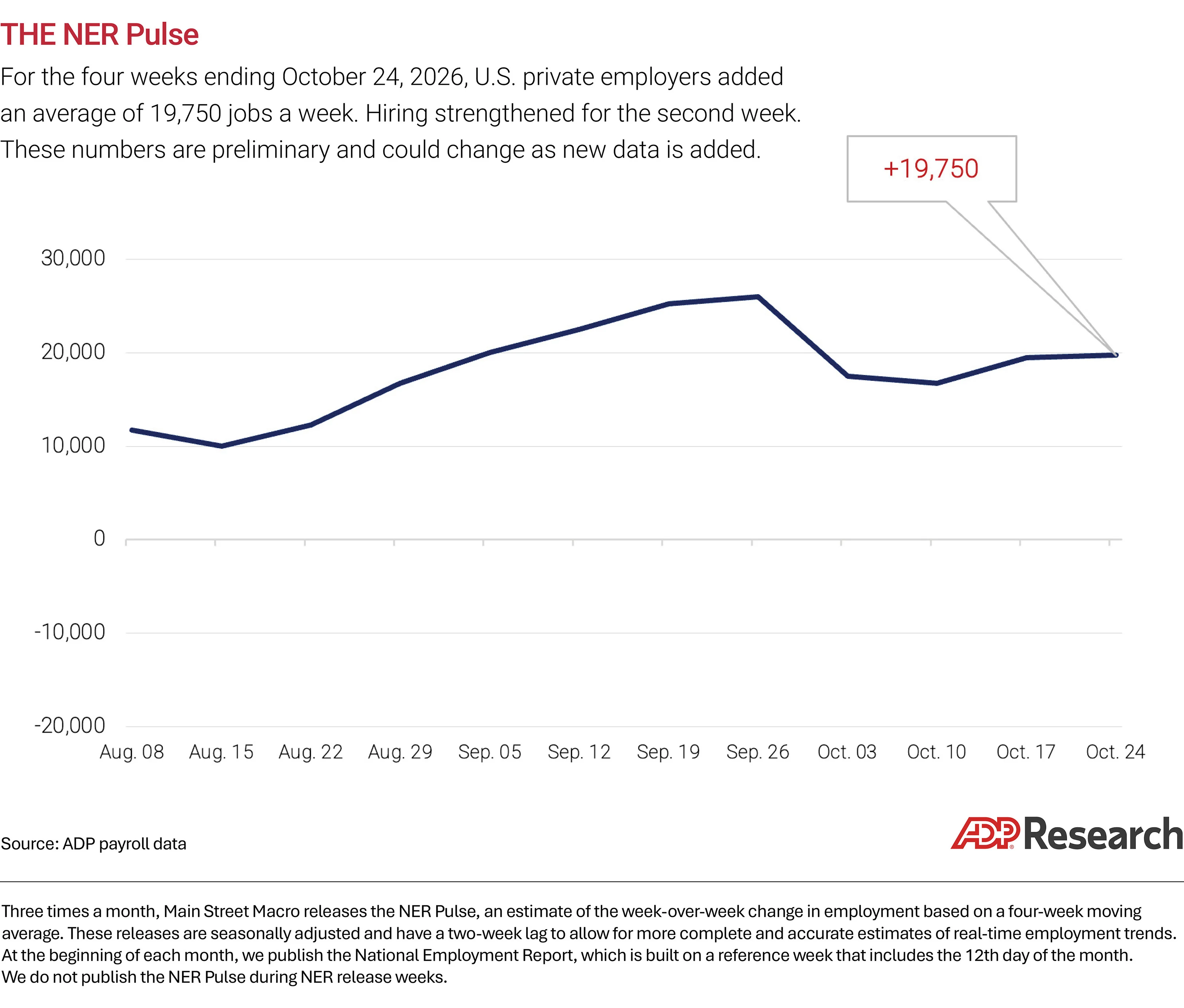
Download this week’s NER Pulse data.

The week ahead
Tuesday. The Consumer Price Index, a measure of inflation, accelerated Iin September from August. I'll be watching today’s release from the Bureau of whether energy-driven price pressures are broadening across goods and services.
Thursday. Weekly initial jobless claims reported by the Department of Labor remain historically low, but rising long-term unemployment suggests claims aren’t telling the labor market’s full story.
With mortgage rates above 7 percent for six straight weeks and September sales down 2.2 percent from a year ago, October’s existing home sales data from the National Association of Realtors is likely to show continued cooling in housing demand.
Friday: After wholesale inflation hit a four-year high last month, I'll be watching for signs that producer price pressures are moderating and becoming less broad-base when the BLS releases the October Producer Price Indexes.