



 4 min read
Nela Richardson, Ph.D.
It’s probably not surprising that soccer is the world’s most popular sport, with an estimated 3.5 billion fans. This year’s soccer matches have drawn more than 4.6 million people so far, a record, according to FIFA.
But another global tournament is under way, too. It’s the competition for labor, with a roster of workers more than 3.7 billion strong.
Both of these competitions reward highly skilled talent, benefit from worker mobility, and are big economic drivers.
Today, I invite you to take a short break from this year’s soccer semifinals for a look at the global playing field for labor.
Unemployment is low
The global unemployment rate has been low and stable at 4.9 percent for the past three years, and the International Labour Organization projects that it will remain low through 2027. In the decade leading into the Covid-19 pandemic, global unemployment averaged 6 percent.
A few factors have kept the labor market in top shape, including stable global growth, investment in artificial intelligence technology, and supportive monetary and fiscal policy, according to the ILO.
However, one factor looms large. The world’s aging population is keeping the labor supply tight as more people age out of the workforce. A surge in retirees is expected to end or even reverse employment growth in high-and-middle income countries.
Low-income countries, by contrast, could outpace the world’s pre-pandemic level of employment growth thanks to an influx of young workers. In these markets, employment is expected to grow by 3.1 percent in 2026, compared to an average of 2.3 percent a year between 2010 and 2019.
Wages are up, but so is inflation
In the 38 large economies that make up the Organization for Economic Cooperation and Development, average annual wage growth hit a high of 2.4 percent in 2024. In 2025, wage growth slowed to 1.2 percent year over year, but that still was comfortably faster than the 0.7 percent average growth that marked the decade before the pandemic.
The bad news is that inflation also has climbed and is now stuck at higher-than-average levels worldwide.
As much as labor markets are characterized by their stability, this ongoing tension between wage growth and inflation has locked global pay in a head-to-head struggle with an elevated and increasing cost of living.
The informal sector
If you’ve ever held a job babysitting or shoveling snow for a neighbor, you’ve participated in the informal economy, which is estimated to employ over half of all workers worldwide, according to the ILO.
The informal economy comprises jobs in which neither the employer nor worker is taxed or otherwise recognized by governments. It’s a market characterized by low pay and few worker protections.
Although the informal labor market is understandably difficult to measure, its impact on the global economy is important and far reaching, providing essential goods and services and expanding the world’s productive capacity.
My take
The global labor market has enjoyed an unprecedented level of stability since the end of the pandemic, but this stability has obscured crosscurrents of structural change that are buffeting the economy.
- Demographic shifts are scrambling the talent pipeline as a growing share of workers in wealthy countries exit the labor force and the number of young workers in low-income countries starts to multiply.
- Higher-than-average inflation has eroded the purchasing power that has accompanied widespread employment and robust wage growth. The result is less-vigorous economic growth.
- Advances in artificial intelligence are set to restructure formal and informal labor markets, bringing new tools and transitions.
The upshot is that national labor markets are becoming more globally integrated than ever before. Employers are of all sizes are hiring globally, not just locally. And while the soccer tournament happens only once every four years, the labor market operates 24-7 in an increasingly interconnected field of competition for workers.
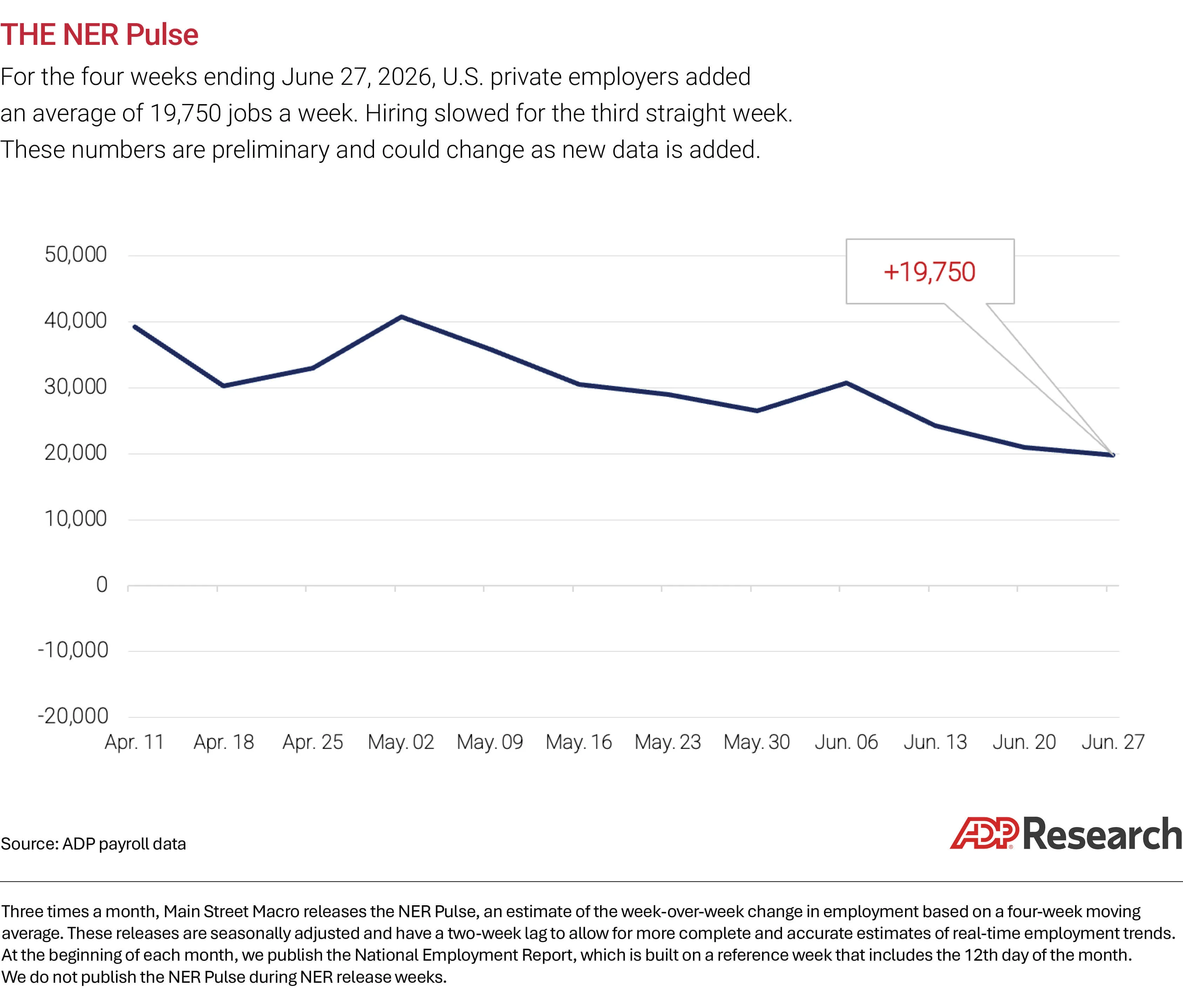
Download this week's NERP Pulse Data.

The week ahead
The week ahead
Tuesday. This busy data week begins with the June Consumer Price Index from the Bureau of Labor Statistics. In May, a surge in gas prices pushed headline inflation up to 4.2 percent from a year earlier. Economists will be watching to see if prices fell back last month.
Wednesday. The Producer Price Index is a leading indicator that hints at the future level of inflation for consumers. Right now, the future looks pricey. In May, the year-over-year increase in prices paid by producers, minus food and energy, soared to 5.1 percent, its highest level since October 2022. June data from the BLS will give us an update.
Thursday. Economists and market-watchers will get a signal of how consumers are responding to inflation growth with a look at June retail sales data from the Census Bureau.
Friday. The week ends with June housing starts from Census and a first look at July consumer sentiment from the University of Michigan. May housing starts were 8.7 percent below last year’s reading. Consumer sentiment showed a rare uptick in June despite higher inflation.