



 3 min read
Nela Richardson, Ph.D.
For employers and workers alike, the question is no longer if artificial intelligence will reshape work, but how quickly and where. To answer those questions, the Stanford Digital Economy Lab and ADP Research have collaborated to launch the first career-focused measure of AI’s impact on the labor market.
The Canaries Dashboard, built on ADP payroll data, is a near real-time monitoring tool based on “Canaries in the Coal Mine? Six Facts about the Recent Employment Effects of Artificial Intelligence,” a Stanford paper that examined AI-exposed occupations and industries for early signals of AI’s effect on wages and the economy.1
The dashboard is one in a set of AI economic indicators Stanford has built to track and measure the impact of these emerging technologies on the economy.
An early detector
By tracking employment growth by occupation, age, and AI exposure level, the Canaries Dashboard gives us an early indicator system for the labor market.
Putting a microscope to a curated sample of ADP payroll data of 25,000 employers, 4 million workers, and more than 730 occupations, the dashboard can detect changes in hiring and employment in specific occupations and career stages before those effects become visible in aggregated labor-market statistics.
It has already shown us AI’s effects on software development, customer service, and other high-exposure occupations, and its lack of impact on low-exposure work such as home health care.
In the aggregate, AI’s impact on jobs remains modest. Since the introduction of ChatGPT in late 2022, annual employment growth in AI-exposed occupations has increased by 1.1 percent, compared to 2 percent for the least-exposed roles.
When AI’s impact is measured by career stage, however, dramatic differences emerge. For workers aged 22 to 25, employment in highly AI-exposed occupations has been shrinking by 3.8 percent a year, while the least-exposed jobs continue to grow at an annual rate of 2 percent.
Where the canaries sing
AI can automate workflow or augment it. When work is automated, the technology executes individual tasks. When work is augmented, AI acts as a teammate who helps people complete, accelerate, and scale their work.
The Canaries Dashboard also reveals how the type of AI usage affects employment. Occupations primed for AI augmentation have shown more enduring employment growth than occupations where AI is used to automate.
My take
The debate around AI and jobs has been dominated by forecasts and, frankly, guesswork. Will AI replace workers? Augment them? Create new roles?
The reality is more nuanced. AI acts from the bottom up, at the task level, rather than the top down.
The dashboard captures this task-level change to reveal where AI’s true value – and its risk – lie. In occupations and career stages where AI amplifies human abilities and potential, we see employment growth.
With this value in mind, the Canaries Dashboard can help employers, workers, and policymakers move from guesswork to informed decision-making to shape the future of work, one task, one occupation, and one career stage at a time.
Note: Some readers last week noticed that our National Employment Report data history file didn’t match what we’d been reporting in NER Pulse. The file we released was based on an outdated reference file. We’ve updated that file and the accurate data can be found here. Thanks for the catch!
Main Street Macro will be on hiatus next week. The NER Pulse will be released as scheduled on June 23.
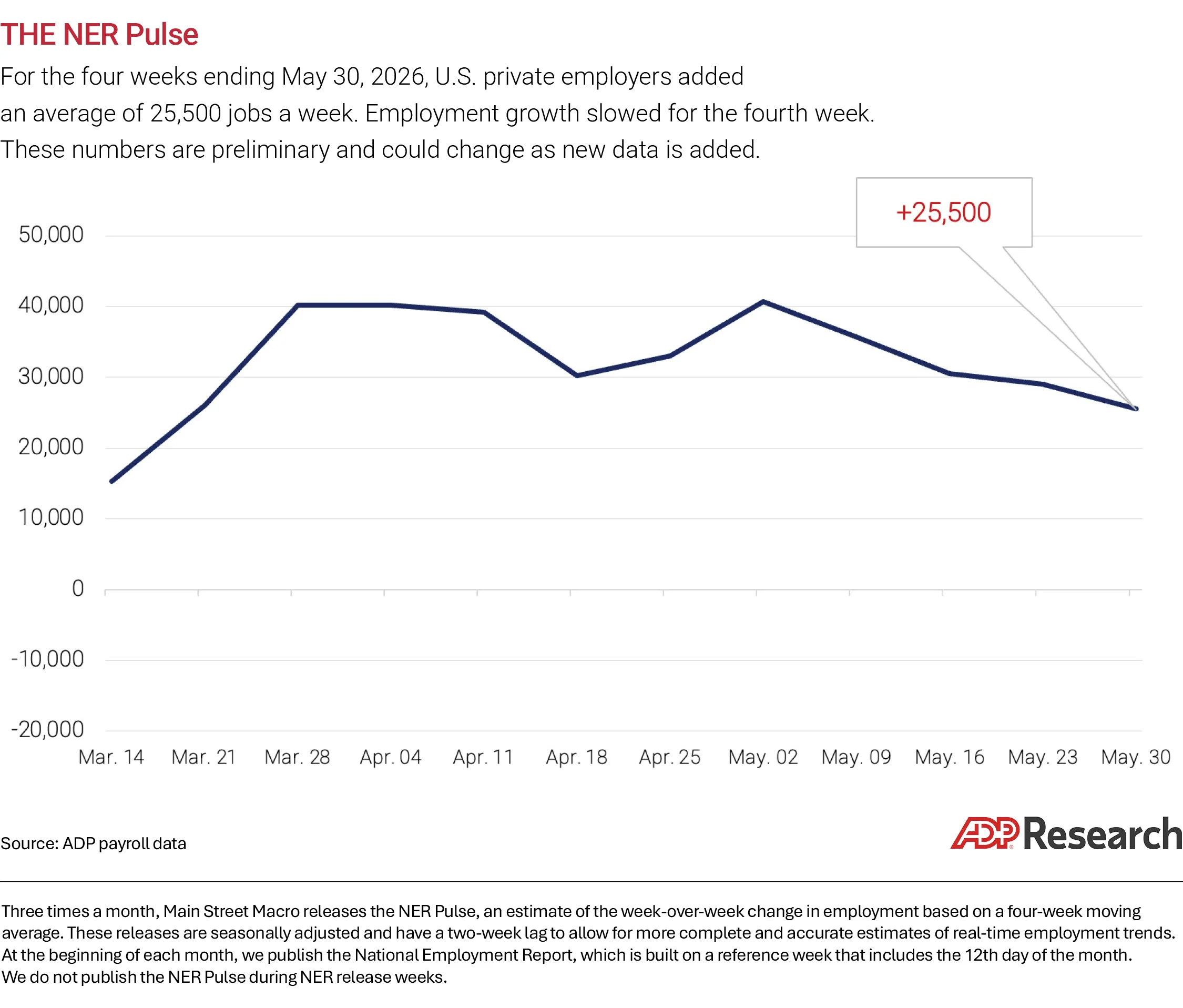
Download this week's NER Pulse data

The week ahead
Tuesday. This jam-packed, holiday-shortened week kicks off with May residential construction data from the Census Bureau. The pace of homebuilding slumped nearly 3 percent in April due to our continuing trifecta of costly financing, labor shortages, and the high cost of materials. These constraints continue to exert their influence.
Wednesday. Last month’s Census data showed retail sales shooting to their fastest pace of growth since January 2023, suggesting that this part of the economy, at least, was immune to the housing market’s demand-dampening trifecta. But with a recent uptick in inflation, we’ll see if retail spending remains unflappable.
The week’s highlight is the Federal Reserve’s policymaker meeting, the first to be led by new Chair Kevin Warsh. Given the solid labor market and upward movement of inflation, Fed watchers put the odds of a rate cut at near zero.
Thursday. Weekly jobless claims, a proxy for layoffs from the Labor Department, crept up last week but are still far too low to warrant any concern.