



 3 min read
Nela Richardson, Ph.D.
As an industry, leisure and hospitality runs on loyalty. This is especially true in summer, when travelers crowd airlines, restaurants, and hotels. All of these sectors make extensive use of brand loyalty points to lure and retain customers with a promise of lower-priced service.
But loyalty incentives aren’t just a tool for retaining customers. Leisure and hospitality is unique in the labor market as a sector that rewards worker longevity with higher wage growth.
In most industries, job-changers are incentivized by a lucrative payoff that exceeds what they might have earned through pay raises at their past employer. Leisure and hospitality is the only industry we track in which job-stayer pay growth consistently outstrips job-changer pay growth.
This finding is more than a statistical curiosity. It’s a structural tell. Worker loyalty was tested when the pandemic triggered a collapse in demand for in-person services, followed by a whipsaw rebound. Restaurants, hotels, and other leisure and hospitality employers had to rethink what it took to hire and – more importantly – keep workers. In the end, they were forced to adopt aggressive pay increases just to stabilize their workforce.
The result is a rare configuration: Internal wage progression now outpaces job-switching pay premiums, suggesting that retention, not turnover, has become the dominant wage-setting mechanism.
Since the pandemic, pay growth for leisure and hospitality employees who have been in the same job for at least 12 months has been stronger than pay growth for people who changed jobs during that period. Job-stayers in the industry saw a 2.2 percentage-point pay premium over job-changers, who in the big picture typically enjoy a 2.2 percentage-point pay premium.
Still, while employers in this industry reward longevity, newcomers are common. About 16 percent of the industry labor force is composed of people who joined their employers in the last three months. That’s four times the share of new hires across the 10 large industries we track.
My take
The story here isn’t just about higher pay. It’s about labor market pressure points. In leisure and hospitality, the biggest wage gains don’t accrue to people chasing better offers elsewhere. They accrue to those workers who stay put, because staying put is exactly what the system is trying to incentivize.
Main Street Macro will be on a summer break next week. I’ll be back in August. The NER Pulse will be released on its regular schedule July 28.
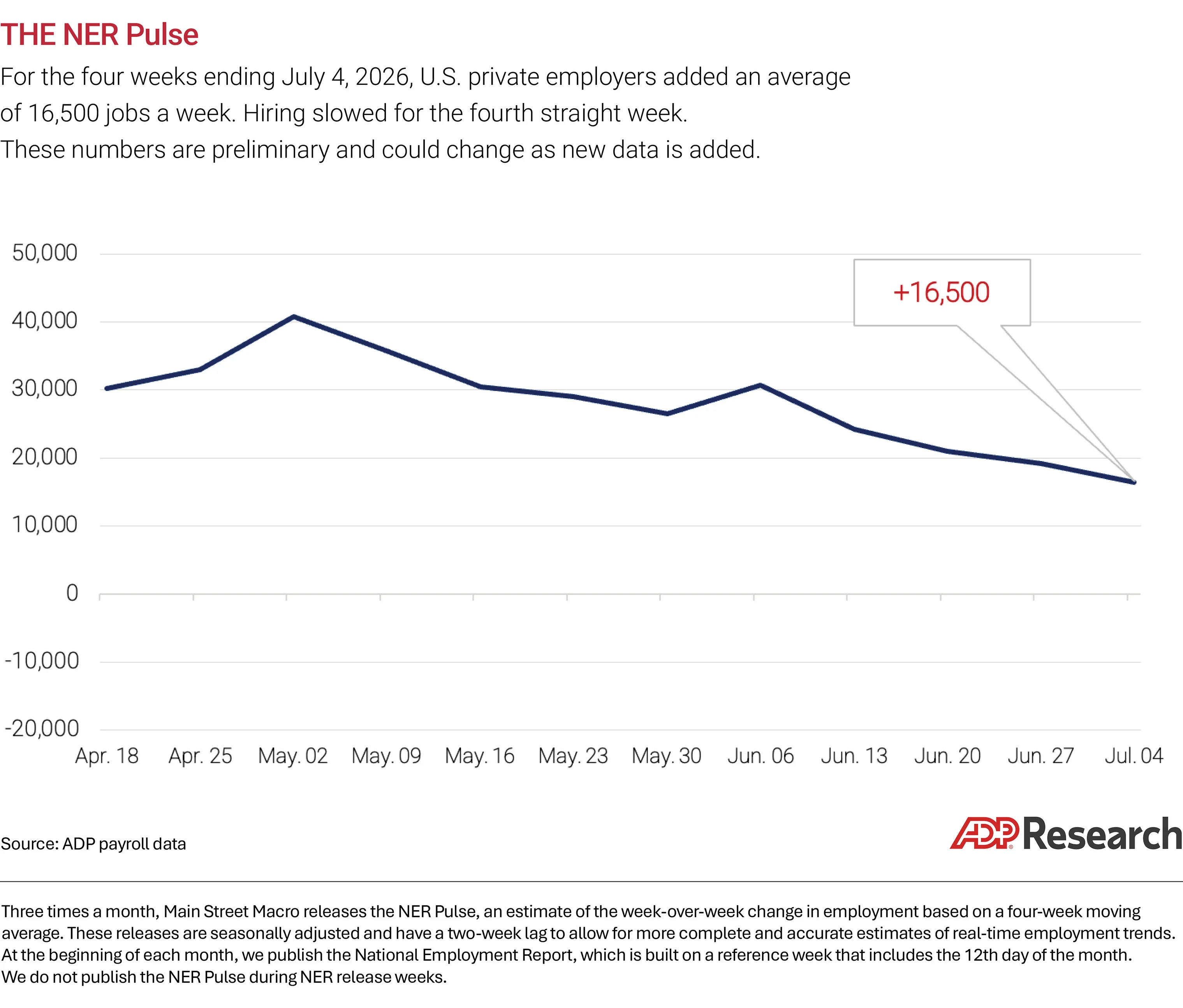
Download this week's NERP Pulse Data.

The week ahead
Tuesday. ADP Research releases the latest issue of our flagship publication, Today at Work, with a cover story showing how the org chart is remapping U.S. employment. Our July read on work sentiment, the Employee Motivation and Commitment Index, also is released today.
Wednesday. The Canaries Dashboard, a project of the Stanford Digital Economy Lab built on ADP payroll data, will provide a near–real-time signal of AI’s impact on jobs, wages, and the economy.
Thursday. We’ve seen tension between very low levels of initial jobless claims and the rising percentage of long-term unemployed workers. The former suggests continuing strength, the latter growing weakness. That’s why, even after years of historically low unemployment, economists will continue to watch this weekly Labor Department release.
Friday. New home sales slowed in April and May compared to a year ago. I’ll be watching June data from the Census Bureau to see if that trend has continued.