



 3 min read
Nela Richardson, Ph.D.
U.S. consumers have proven surprisingly resilient this year. Spending has held up in the face of lingering inflation pressure even as many households report feeling stretched.
A closer look at pay gives us two reasons why.
The first is wage growth. By this measure, the labor market has largely normalized. The rapid wage acceleration that we saw after the pandemic has slowed, and wage increases are remarkably similar across income groups.
But when we look beyond wages to gross pay, a different pattern emerges. Lower-income workers continue to see substantially faster earnings growth than higher-income workers.
In a K-shaped economy, individual fortunes diverge based upon income. Higher-income workers increase spending power through higher wages and earnings, and investment returns, while lower-income workers struggle to keep up with inflation amid weak wage growth.
Looking at the K-shaped economy from the angle of earnings growth suggests the current resilience in consumer spending might be on fragile footing.
Convergence in base pay
In October 2026, year-over-year growth in wages, or base pay, had largely converged across the income distribution, according to our Pay Insights data.
This is a dramatic shift from what we saw during the labor shortages of 2021 and 2022.
At the peak of the labor-market frenzy, lower-paid workers were receiving double-digit pay increases while higher earners saw more modest gains. Today, annualized pay increases are clustered between 3 percent to 3.5 percent, regardless of a person’s place in the income distribution.
Viewed through the lens of wage growth alone, the labor market appears unusually balanced.
The story changes when we look at earnings
Gross pay, or earnings, captures everything that ultimately shows up in a paycheck, including hours worked, overtime, shift differentials, bonuses, commissions, and other compensation.
And here the picture looks very different. In October 2026, growth in gross pay was sharply skewed toward lower-income workers.
The gap is striking. For the lowest-paid workers, earnings growth is nearly four times faster than wage growth. By contrast, earnings growth and wage growth are much closer together for most higher-income workers.
The implication is clear: Lower-income workers aren’t getting dramatic raises. They appear to be earning more because they’re working more.
A different kind of labor-market advantage
Immediately after the pandemic, lower-income workers benefited from an extraordinary surge in bargaining power. Employers raised wages aggressively to attract and retain people in leisure and hospitality, retail, transportation, health care support, and other frontline occupations.
For these workers, today's labor-market advantage looks different. Instead of higher wages, lower-income workers are accessing more hours, more overtime, and more opportunities to earn supplemental compensation.
In other words, employers are utilizing the labor supply more intensively at the lower end of the wage distribution.
My take
When earnings rise because hourly wages rise, households become permanently more affluent. Higher wage rates raise future income potential and strengthen purchasing power over time.
When earnings rise because workers put in more hours, the boost to spending power can be more fragile and fleeting. Additional shifts, overtime, and multiple-job work arrangements can support consumption in the short run. But they depend on workers continuing to supply more labor.
That's an important consideration as consumer spending continues to outperform expectations and we enter the holiday shopping season. The strength of the consumer isn’t coming just from accelerating wages. It’s also dependent on lower-income workers doing more work.
Main Street Macro will be on hiatus until December. A joyous Thanksgiving to you and yours.
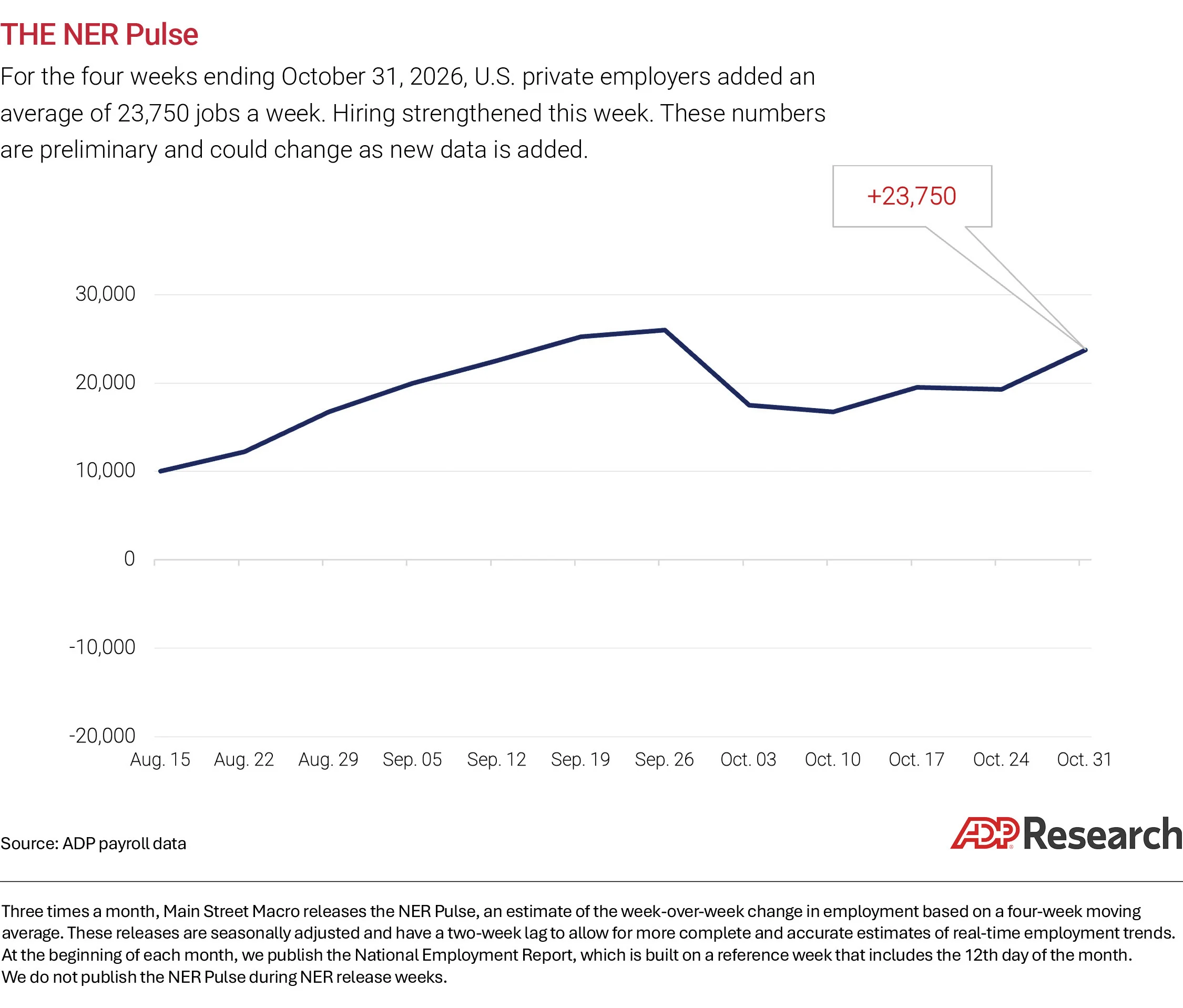
Download this week’s NER Pulse data.

The week ahead
Tuesday. Retail sales posted a strong headline gain in September, but consumer spending stripped of volatile categories such as gasoline was softer. October's retail sales report from the Census Bureau will tell us whether consumer spending is beginning to lose momentum as the year draws to a close.
Wednesday. October data on housing starts from Census will show whether builders are still constrained by elevated financing costs and labor shortages despite persistent housing demand.
Thursday. Initial jobless claims data from the Department of Labor is likely to grab the headlines, but I’ll be watching continuing claims made by the long-term unemployed. Continuing claims have eased in recent months after rising through much of 2024 and 2025, but the size of this group remains elevated. The key question is whether the long-term unemployed are finding jobs or simply exiting the unemployment rolls.
ICYMI. The ADP Research Employee Motivation and Commitment Index, which tracks how U.S. workers think and feel about their jobs, improved for the third month in November.