



 5 min read
Nela Richardson, Ph.D. , Liv Wang
U.S. employment reports for September painted a familiar picture of the labor market. Headline totals changed from month to month, but the underlying story was remarkably consistent. Health care remained the most reliable source of job growth. Leisure and hospitality continued to add workers despite concerns about consumer sentiment. And finance and professional business services, two traditional white-collar engines of job creation, remained soft.
Then there was manufacturing, which stood out for a different reason.
Recent hiring in this sector has been steady, not spectacular. But if we look beyond payroll counts, we see a manufacturing economy that might be stronger than the employment data suggests.
Manufacturing employment growth is modest, but the sector deserves attention because it is affected by several powerful forces at once: industrial investment, reshoring, infrastructure spending, technology buildout, and demographic-driven labor shortages.
Unlike health care, where labor demand has been strong for years, manufacturing is searching for equilibrium. Its employment counts alone might not fully capture what’s happening on factory floors.
Many manufacturing facilities operate around the clock, relying on two and three shifts to maintain production schedules. Employers often face multiple hiring challenges simultaneously: finding people with the right technical skills, replacing retiring workers, and recruiting people willing to work nontraditional hours.
Given these pressures, manufacturers frequently respond to changing demand by adjusting hours before they adjust headcount. This approach makes overtime pay an important labor market signal.
When demand strengthens, employers often increase overtime hours and shift utilization before committing to permanent hiring. When demand weakens, overtime typically is one of the first costs to be reduced. Hence, changes in overtime earnings can provide an early indication of production activity that might not yet appear in employment totals.
Manufacturing’s pay signal
In ADP pay data, the distinction between base pay and gross pay is especially useful. Base pay reflects wage rates and labor-market tightness. Gross pay captures something broader: hours worked, overtime, bonuses, commissions, and other forms of compensation tied to economic activity.
For manufacturing workers, where shift work and overtime are common, gross pay data can give us insight into how busy factories really are. Overtime and base pay data help fill that gap.
Average weekly hours worked in manufacturing rose to 45.6 hours in September, up 1.7 percent from a year ago, the strongest increase in several years. Over the same period,the sector’s year-over-year gross pay growth accelerated to 5.5 percent, up from 4.9 percent during the same period prior. Gross pay is rising faster than base pay because workers are spending more time on the job.
Moreover, workers who changed manufacturing jobs over the past year saw a 5.3 percent increase in their base pay, compared with 3.4 percent growth for job-stayers. The premium for changing jobs in this sector has widened significantly over the past year, suggesting manufacturers continue to compete aggressively for skilled talent.
And the gap is even larger when looking at gross pay, which reflects total earnings. Manufacturing job-changers experienced 10.0 percent gross pay growth, double that of workers who stayed with their employer. This difference reflects not only better wages, but greater opportunities for overtime and additional hours.
Rising hours, accelerating gross pay, and growing wage premiums mean manufacturers are asking more of the workers they already have even as they continue to pay up for scarce talent.
Following the investment cycle
The factory floor is getting busier in industries that supply the building blocks of economic growth. ADP payroll data shows that manufacturers that produce construction materials, industrial chemicals, electrical equipment, primary metals, transportation equipment, and technology hardware are experiencing some of the largest increases in hours worked.
These employers often are among the first to feel changes in investment demand because they make the materials, components, and equipment needed for everything from factories and power systems to semiconductor plants and data centers.
Notably, the strongest gains aren’t concentrated in consumer-oriented industries such as apparel, beverages, or household goods. Instead, they’re occurring in sectors tied to capital spending and infrastructure. The common thread is demand for physical capital and the workers needed to build it.
When manufacturers of steel, electrical equipment, chemicals, and technology components ask employees to work longer hours, it’s often a sign that companies are building, expanding, and investing for future growth rather than simply responding to a short-term surge in consumer purchases.
Our take
Right now, factory workers are spending more time on the job, earning larger pay premiums when they switch employers, and seeing stronger growth in total earnings than base wages alone would suggest. Combined, these datapoints signal that demand across important parts of the goods-producing economy remains firm, even if headline employment growth appears modest.
Sometimes the most important labor market story isn't how many people are working. It's how much work is getting done.
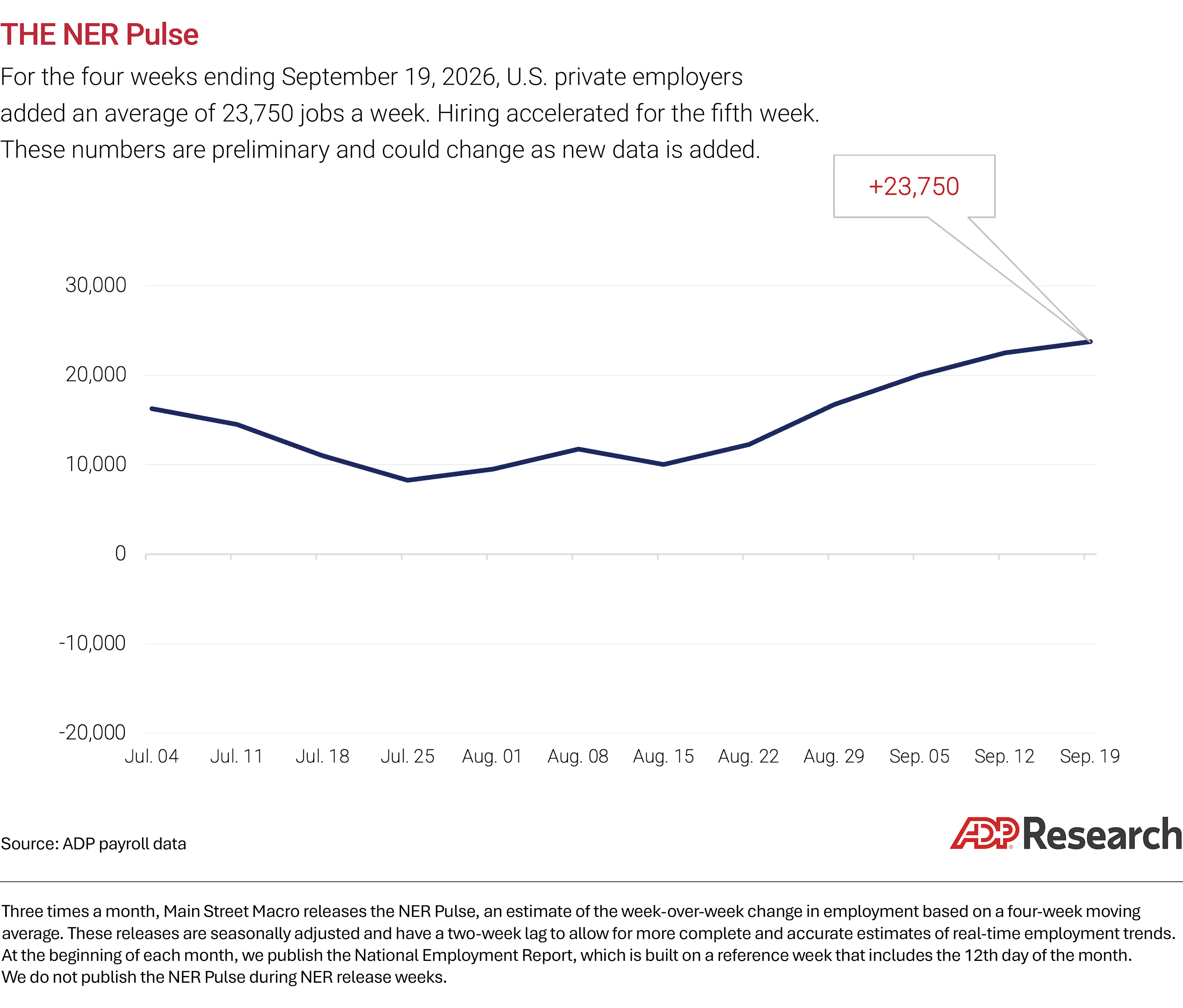
Download this week’s NER Pulse data

The week ahead
Thursday. The Bureau of Labor Statistics reported a deceleration in job growth in September compared to the prior month, but it’s likely that today’s initial jobless claims data from the Labor Department will continue to signal a low level of layoffs. I’ll also be watching the direction of continuing claims for a signal of how workers who have unemployed for a long period of time are faring.
Friday. A solidly growing economy has done nothing to lift the mood of consumers. The University of Michigan’s index of consumer sentiment is down 15 percent since the beginning of the year. I’ll be checking to see if prices again top the list of concerns when the University of Michigan reports preliminary data for October.