



 4 min read
Nela Richardson, Ph.D.
This week, ADP Research and American Public Radio’s Marketplace bring you the final installment in our two-year series, The Age of Work, with a final stop in the Indian financial capital of Mumbai. With a workforce that ranks among the world’s youngest, this city is at an important economic crossroads.
Over the past two years, The Age of Work has explored how demographic change is affecting labor dynamics and changing how economies work. In the United States, we visited an exceptionally old community and an exceptionally young one experiencing rapid growth. We stopped in the United Kingdom, which is further along the aging path than America. Most recently, we traveled to Vietnam, a country in the midst of a demographic golden age.
India offers a different perspective altogether.
While much of the developed world is aging, India remains remarkably young. The country's median age is just 29, compared with 39 in the United States. More than two-thirds of its population is of working age, a share expected to grow before peaking around 2030. With nearly one billion working-age people, India is positioned to become an increasingly important source of labor, innovation, and economic growth in the decades ahead.
Walking through Mumbai, sometimes called the New York of India, the scale of that opportunity is impossible to miss. More than 20 million people live in the city, where global banks, technology companies, entrepreneurs, government offices, and Bollywood all compete for talent.
Challenge and opportunity
Mumbai is home to extraordinary wealth and investment, yet India remains one of the world's most extreme examples of wealth inequality. The country is producing a growing number of billionaires while millions of people still depend on government food assistance.
This disconnect is at the heart of what economists call the demographic dividend. Economies benefit when a large share of the population is working, earning, and investing. To capitalize on this opportunity, India must expand education, create high-quality jobs, bring more women into the workforce, and help people move up the economic ladder.
One statistic highlights the country’s challenge: Only about one-third of women participate in India's labor force, well below participation rates in the United States, Vietnam, and many other economies. Unlocking that talent might be one of the country's greatest opportunities for future growth.
Tension beneath the optimism
One of the most striking findings from this year’s ADP Research Global Workforce Survey is how enthusiastically Indian workers have embraced artificial intelligence. More than 4 in 10 workers we surveyed over the summer said they use AI at work nearly every day, the largest share of any country and more than double the global average. Only a tiny fraction of our survey respondents in India say they have never tried AI.
Workers in India also are surprisingly optimistic about what comes next. Nearly 1 in 3 strongly agree that AI will improve their job responsibilities. And of the 37 markets we surveyed, India ranks among the best for worker confidence in skills development, career advancement, and employer investment in skills.
Yet even as workers report confidence in their prospects, engagement at work remains stubbornly low and continues to decline. Only 12 percent of workers in India report being fully engaged on the job, roughly half the level recorded in 2023.
The trend is especially pronounced among younger workers. Among 18- to 26-year-olds, the share of people who describe themselves as fully engaged fell from 12 percent to just 6 percent in a year. The share of fully engaged workers aged 27 to 39 fell from 15 percent to 13 percent. Among 40- to 54-year-olds it fell from 19 percent to 12 percent. Engagement among older workers also has softened.
The same workforce that is rapidly adopting AI, investing in education, and expressing confidence about the future is also reporting weaker emotional connection to work today.
My take
India maintains significant economic advantages. It has a large labor force, strong growth, increasing digital connectivity, and workers who are remarkably optimistic about learning and adapting. The country’s future will depend on whether it can convert its young population into a skilled, productive, and upwardly mobile workforce.
Mumbai’s economy is racing toward the future. But this race isn’t about population growth. It's about turning human potential into economic progress. Mumbai’s message – the countries that thrive will be the ones that invest most effectively in their people.
With assistance from Jared Northup.
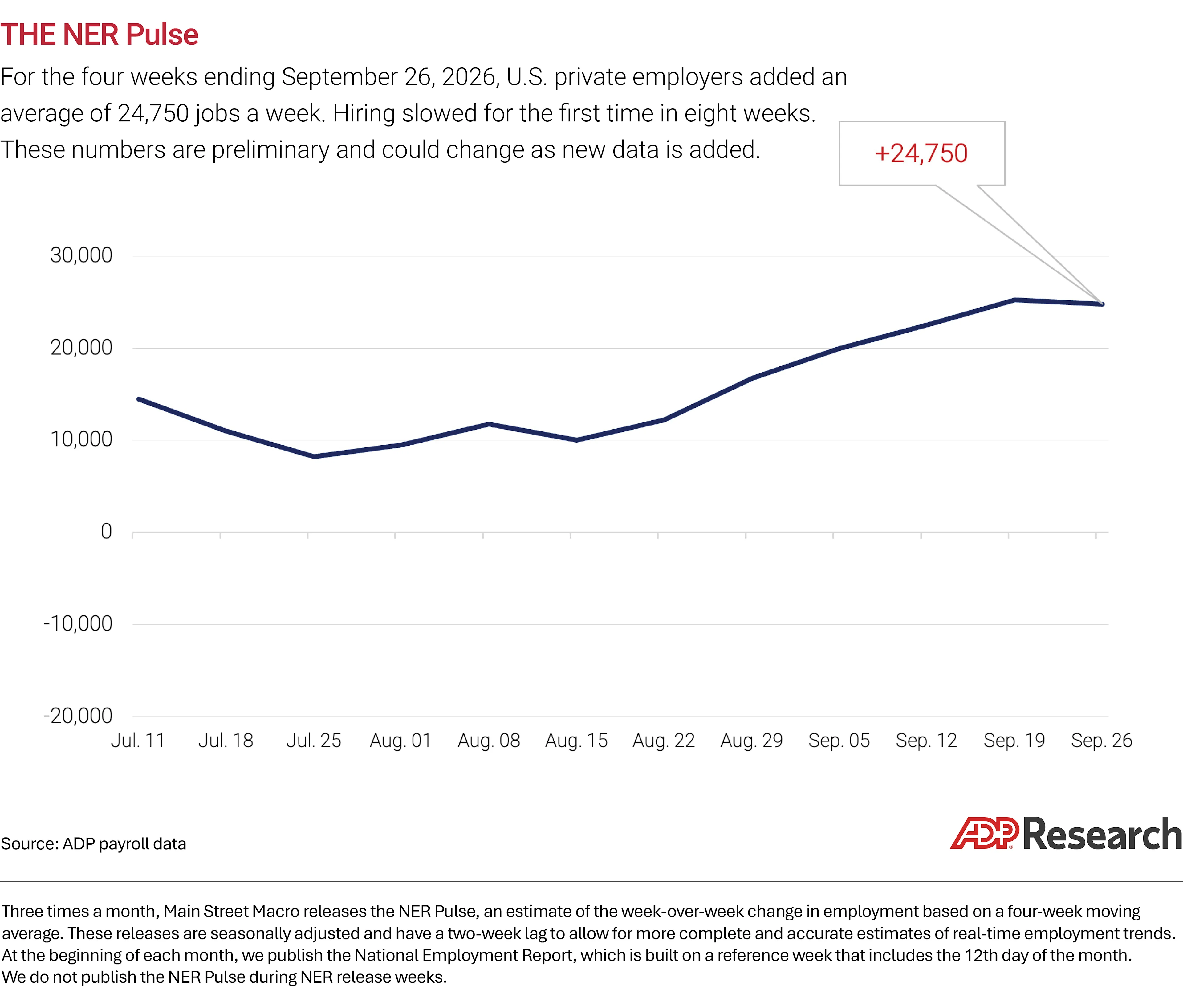
Download this week’s NER Pulse data

The week ahead
Tuesday. An action-packed data week starts with a view of the housing market and how existing home sales fared in September. This monthly snapshot from the National Association of Realtors won’t capture October’s uptick in borrowing costs that has pushed mortgage rates above 7 percent.
Wednesday. Data on September consumer prices will answer two questions. Did energy prices boost headline inflation, and did moderating housing prices and service costs help keep core inflation in check? The Bureau of Labor Statistics will deliver answers when it releases the Consumer Price Index.
Thursday. Consumers might notice higher prices first at the gas pump, but economists are watching for something bigger: whether these costs are spreading through the supply chain into a broader range of goods and services. That's the key signal I'll be looking for in this week's Producer Price Index report from the BLS.
Also on Thursday, as long-term unemployment rises, economists are watching for the moment when weak hiring turns into more layoffs. We’ll get the newest data on initial claims from the BLS.